
 Daniel J Sait
Crestron UK Residential Sales Director Phillip Pini explores how the rise of hybrid working is creating new opportunities for integrators. As organisations strive to deliver a consistent collaboration experience wherever employees work, the home office is becoming just as important as the boardroom.

Hybrid working has evolved from a temporary solution into a permanent feature of modern business. According to the House of Commons Library, 27% of workers in Great Britain were working in some form of hybrid arrangement in late 2025, while research from Gallup puts the figure in the US at more than half of the workforce. Whatever the exact numbers, the direction of travel is clear. Employees increasingly expect to move seamlessly between home and office without compromising productivity or collaboration.
For the integration industry, that presents both a challenge and a significant opportunity. The focus is no longer solely on equipping meeting rooms. Every location where work happens now has the potential to become a connected collaboration space, creating demand for intelligent, easy-to-use technology that delivers the same experience wherever users happen to be.
Engineering Better Collaboration
Within the corporate environment, the emphasis has shifted towards ensuring remote participants feel as though they are sitting in the room. Intelligent cameras that automatically frame speakers, track conversations and present the best possible view have become standard expectations rather than premium extras. High-quality microphones and sophisticated audio processing are equally important, ensuring every participant can contribute naturally without struggling to hear or be heard.
At the same time, organisations face a new challenge as artificial intelligence becomes embedded within everyday meetings. AI-generated meeting summaries, live translations and intelligent note taking are only as effective as the audio and video feeding those systems. Poor sound quality inevitably leads to inaccurate transcriptions and unreliable meeting records, making high-performance AV infrastructure even more important than before.
The requirement for these solutions is also extending well beyond traditional boardrooms. Small meeting rooms, breakout areas, collaboration spaces and even staff kitchens are increasingly expected to support high-quality video meetings as flexible working patterns continue to evolve.
AI Depends on Quality
The rapid growth of AI-powered collaboration tools has raised the standard expected from workplace technology. Businesses now want solutions that can be deployed consistently across hundreds of meeting spaces without lengthy custom programming or complex user training.
This places greater emphasis on scalable platforms that provide a familiar experience regardless of room size or location. When users can walk into any meeting space and immediately begin collaborating without technical assistance, organisations benefit through improved productivity, fewer IT support requests and higher employee satisfaction.
Importantly, the relationship between AI and AV is two-way. Artificial intelligence can optimise camera framing, speaker tracking and noise reduction, while equally relying on high-quality audio and video inputs to deliver accurate outputs. Investing in better collaboration technology therefore improves both the user experience and the effectiveness of AI-driven meeting tools.
The Home Office Matters Too
While businesses have invested heavily in office collaboration spaces, attention is increasingly turning towards the home office. Remote workers are becoming far more discerning about the quality of their own working environment, particularly as video meetings have become an everyday part of business.
For some users, the integrated camera and microphone built into a laptop may still be sufficient. However, professionals who regularly present to clients, host webinars or represent their organisation externally often require a much more sophisticated setup.
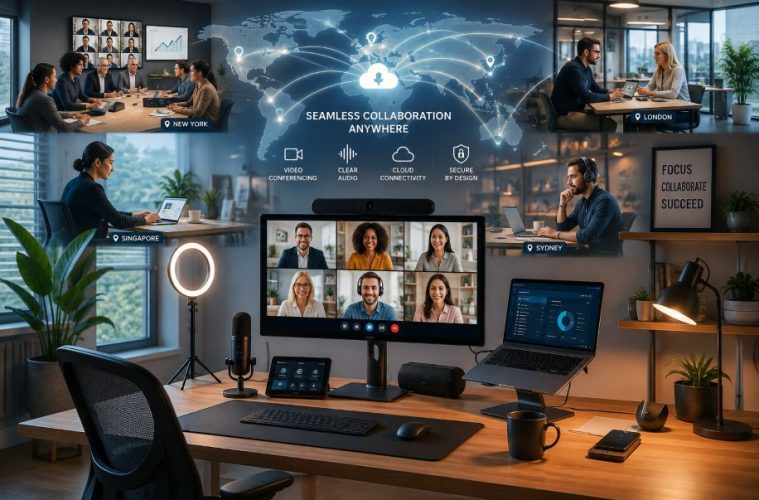
Dedicated cameras, microphones, videobars, speakers and headphones all contribute to a more professional appearance and clearer communication. Lighting also plays a surprisingly important role. Natural light, carefully positioned task lighting or dedicated video lights can dramatically improve on-camera presentation, while thoughtful background design helps create a more polished and professional environment.
Ergonomics should not be overlooked either. Comfortable seating, suitable desk layouts and properly positioned displays all contribute to greater wellbeing during long working days spent on video calls.
Security and Audio Performance
Audio quality presents its own set of considerations within the home environment. Depending on the role, some professionals may require sound isolation to reduce distractions or prevent confidential conversations from being overheard. Others may prefer headphones for concentration, while some benefit from dedicated speakers and advanced microphones combined with intelligent audio processing.
Networking has become equally important. Secure home networks, appropriate firewall protection and, in some cases, dedicated business network connections help ensure sensitive company information remains protected while maintaining reliable connectivity for cloud-based collaboration platforms.
These considerations demonstrate that creating an effective home office now extends well beyond simply supplying a webcam.
A Consistent Experience
Ultimately, the greatest challenge facing organisations is delivering consistency. Employees increasingly expect technology to behave the same way regardless of whether they are working from home, a regional office or corporate headquarters.
Few experiences are more frustrating than losing valuable meeting time trying to connect to systems or troubleshooting unfamiliar technology. Creating a seamless user experience removes those barriers, allowing employees to focus entirely on their work rather than the technology supporting it.
That simplicity also brings measurable business benefits. As Crestron Executive Vice President of Customer Success and Marketing Brad Hintze has observed, organisations that make technology effortless for employees create a genuine competitive advantage. Reducing friction improves productivity while also strengthening recruitment and staff retention, making collaboration technology an increasingly strategic investment rather than simply another IT purchase.
For systems integrators, this shift represents an expanding opportunity. Success will increasingly depend on designing collaboration ecosystems that extend beyond the meeting room, connecting the home office and corporate workplace into a single, seamless experience. As hybrid working continues to mature, delivering consistent, intelligent collaboration wherever work takes place will become one of the defining requirements of the modern workplace.