

 Daniel J Sait
USB-C has rapidly become the default interface in conference room AV. Effi Goldstein, President of the HDBaseT Alliance, examines the implications and challenges.

Announced in 2014, the purpose of USB-C is to replace the chaotic tangle of cables and legacy ports (such as USB-A, USB-B and HDMI) with a small universal connector capable of carrying high-speed data, video and power simultaneously. It quickly comes to dominate personal devices and home office setups, and every new laptop and mobile device is mandated by regulation to support USB-C.
As such, employees can walk into a conference room, plug in a laptop and expect immediate plug-and-play access to displays, microphones, power and everything else they need. The growth of Bring Your Own Device (BYOD) policies and widespread adoption of USB-based peripherals like cameras and videobars further boosts the expectation that USB-C will deliver perfection in the meeting room.
The Hidden Complexity Behind This ‘Universal’ Connector
Unfortunately, USB-C is not designed for professional AV. Providing a consistent experience when using it is a challenge. USB-C is simply a physical connector; the actual capabilities behind it can vary widely depending on the device and cable being used, and the protocols being supported.
For example, a pair of laptops can have identical USB-C ports, yet behave completely differently when connected to the same room system. One may support multiple high-resolution displays and USB-3 data while the other is limited by restricted video output and sluggish performance.
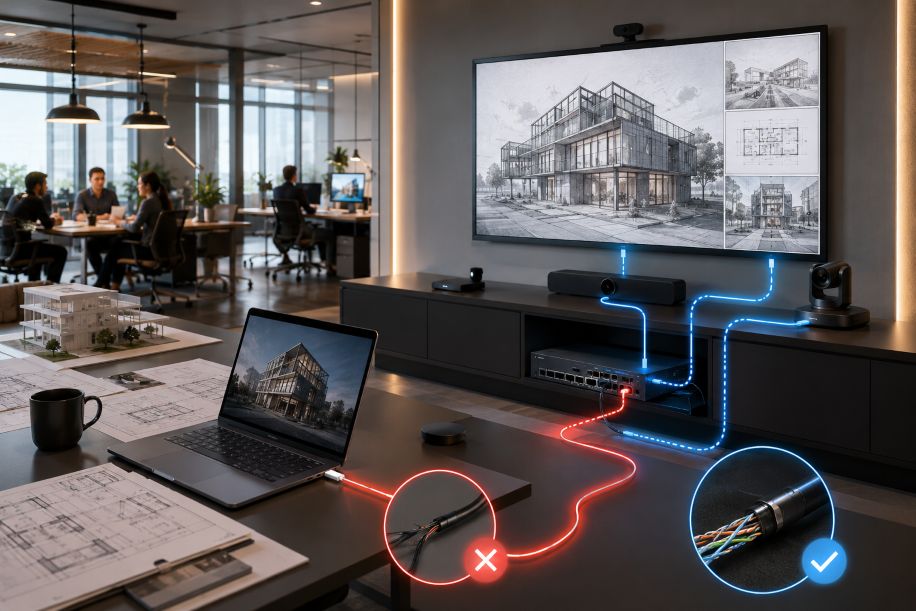
Cable variability also impacts performance and reliability. Two cables with the same USB-C connector may support very different combinations of data transfer speeds, video transport and power delivery. Most integrators have experienced situations where replacing a cable magically restores missing functionality or improves reliability. But that kind of guesswork does not belong in a professional meeting room.
Why Does USB-C Work Well at Home, But Not in the Meeting Room?
In a home office, cables are short and all the devices are positioned close together. In meeting rooms, cameras may be mounted throughout the space, display screens can be positioned far from the table connection point and any number of peripherals may need to operate simultaneously. USB-C very quickly reaches its physical limitations in environments like this.
Distance is a huge problem. High-bandwidth USB connections are sensitive, especially when they are carrying video, USB data and power together. If those signals are pushed beyond 10-15ft, instability is likely. This is why integrators often have to deal with intermittent connections, degraded performance and devices that fail without warning in the middle of meetings.
There are workarounds available, but they are not ideal. Some systems automatically compress video for easier transport, while others downgrade USB-3 peripherals to USB-2 performance levels. This actually happens more often than businesses realise. Many companies invest in high-end 4K conferencing cameras and advanced collaboration tools, only to discover later that the infrastructure is preventing those devices from operating at their full capability.
HDBaseT Can Help
As discussed above, USB-C is an excellent device interface when it comes to simplifying connectivity for laptops, tablets and peripherals, but professional AV environments require longer-distance transport, predictable system behaviour and infrastructure that can support dynamic room requirements.
Technology based on the HDBaseT connectivity standard can help by serving as a bridge between USB-C endpoints and meeting room AV systems. HDBaseT is a professional AV transmission standard that extends video, audio, USB, Ethernet, control signals and power over long distances using standard category cable, while maintaining stable performance for all meeting participants. It is perfectly equipped to handle the protocols carried over USB-C and extend them beyond the limitations of standard USB cables.
For integrators, this means a reliable, streamlined infrastructure that makes USB-C connectivity professional grade.
It also helps systems operate at their full capabilities. Whether an organisation prioritises USB-3 conferencing cameras, multi-display uncompressed video or BYOM workflows where users expect the room to behave like an oversized docking station, HDBaseT can help ensure performance is not compromised somewhere along the signal path.
The combination of USB-C and HDBaseT is an excellent illustration that AV issues often stem not from endpoints, but from infrastructure choices.
Infrastructure: Not to Be Overlooked
Infrastructure planning has become one of the most crucial elements of meeting room design. Decisions made very early on often determine how well the system performs. For example, a conference room may appear fully functional during installation while secretly operating below the capabilities of its devices.
USB-C is here to stay. People love its simplicity and manufacturers are building entire product ecosystems around it. But the connector alone does not solve the transport and infrastructure requirements of professional AV environments.
For integrators and AV designers, the mission is no longer simply to add USB-C connectivity to the room. It is now imperative that they build an infrastructure behind that connector capable of delivering consistent performance without compromise.