

GIK Acoustics is one of the biggest names in residential and prosumer acoustic room treatment, so could this service be a profitable CI project value-add? Richard Stevenson lays down the challenge.
For many integrators, the pursuit of perfect sound tends to orbit around equipment and DSP tuning. Yet the inconvenient truth is that the room itself is often the largest and most unpredictable component in any audio system.
Enter GIK Acoustics, a company that has spent years helping studios, mastering engineers and audiophiles tame troublesome environments with a wide range of acoustic treatments. The company offers a selection of bass traps, diffusers and absorbers, in a massive range of sizes, styles and colours, backed up by in-house design expertise and a rather nifty 3D room modelling software.
Back in 2021, my own newly built cinema room got the GIK treatment as it transpired that two layers of acoustic plasterboard make for a room that sounds like a public swimming bath. That GIK project was an unreserved acoustic success so, spoiler alert, I am already a convert as a direct consumer customer – the company’s biggest market.
More recently, the firm has begun placing greater emphasis on the CI channel, offering installers a way to incorporate professional acoustic design into residential and commercial AV projects without needing a degree in acoustical engineering. GIK handles the acoustic modelling and product specification from supplied room details, and the installer supplies and fits the treatment as part of the overall system design, naturally with margin built into the sale.
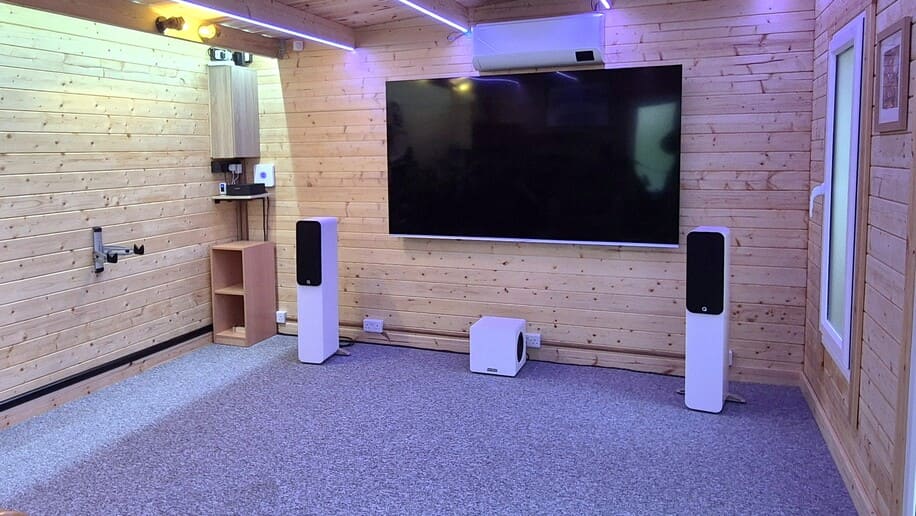
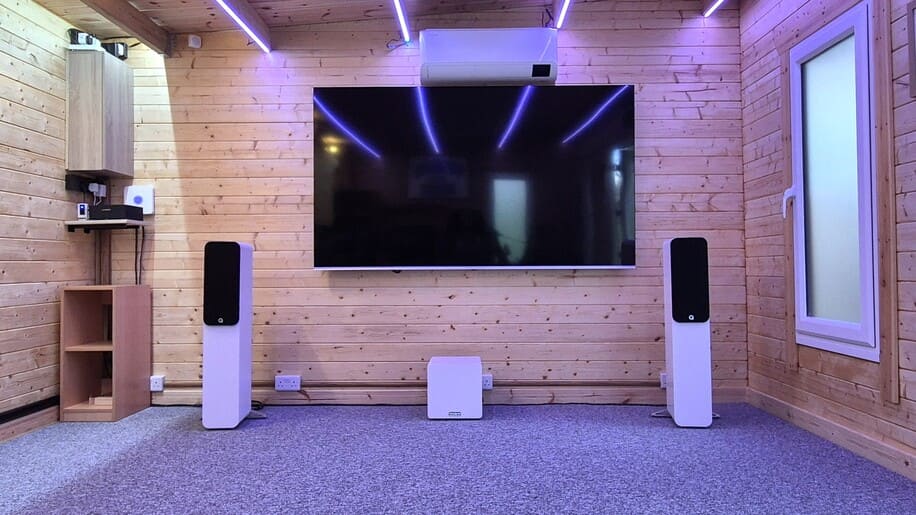
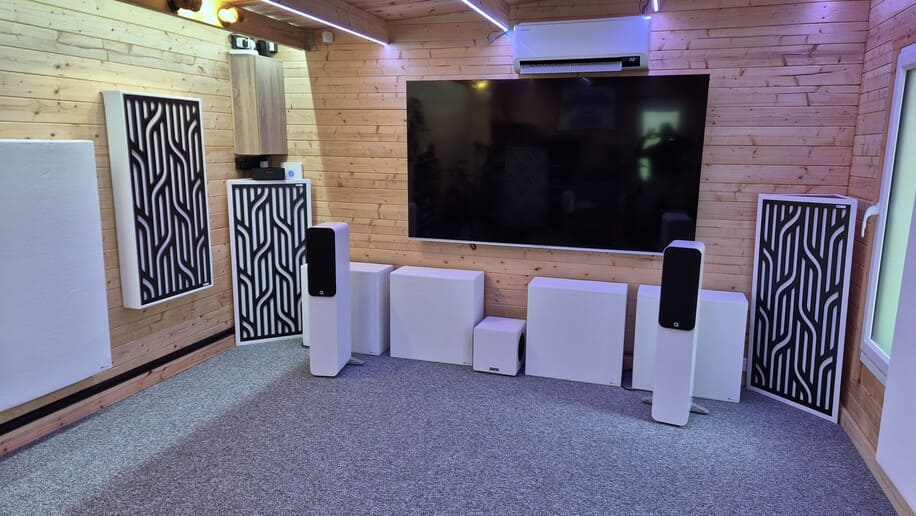
To test that proposition, GIK took on the challenge of treating my new two-channel listening room; a 5.5m by 4.0m timber log cabin. Having been listening and reviewing in the room for the last six months, it’s not acoustically bad. The walls are solid timber logs rather than plasterboard or concrete, which means they absorb and scatter sound energy more naturally than harder, flat surfaces. The ceiling is sloped one-way, which reduces vertical standing waves, and it’s constructed from relatively thin 12mm tongue and groove timber with insulation above it, making it less reflective than a conventional drywall ceiling. Even the small grooves between the stacked logs for the walls contribute subtle diffusion. But could it be improved?
Calling in the Experts
Working with Paul Linke, one of GIK’s senior acoustic designers, the process began with the usual set of measurements and room details: dimensions, layout, floor covering, wall construction, speaker position and listening position, alongside photographs of the room and furniture placement. Accuracy with the tape measure and position of unavoidable obstacles, like a tricky internal ceiling rafter in my case, are paramount, or things won’t fit. As an ongoing EI service to our readers, we make these mistakes so you don’t have to. Moving quickly on, then.
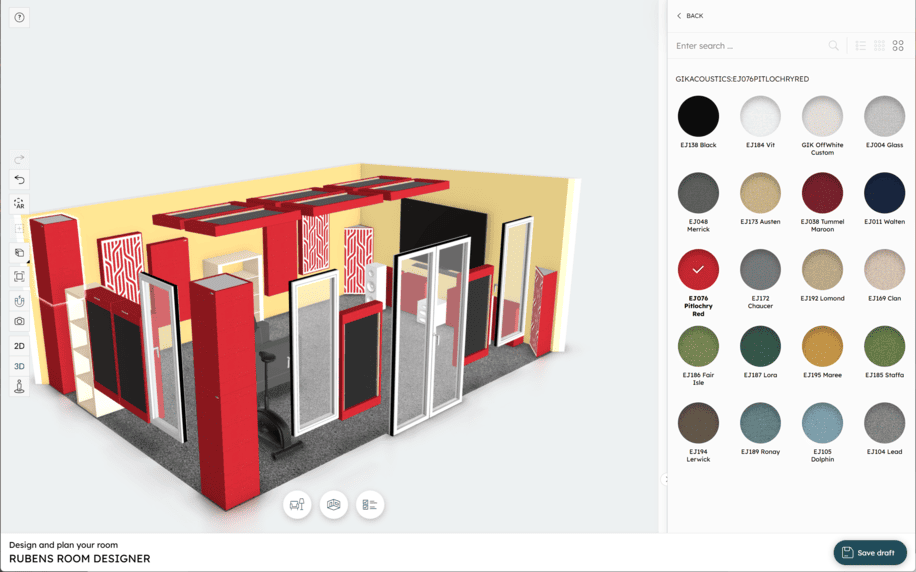
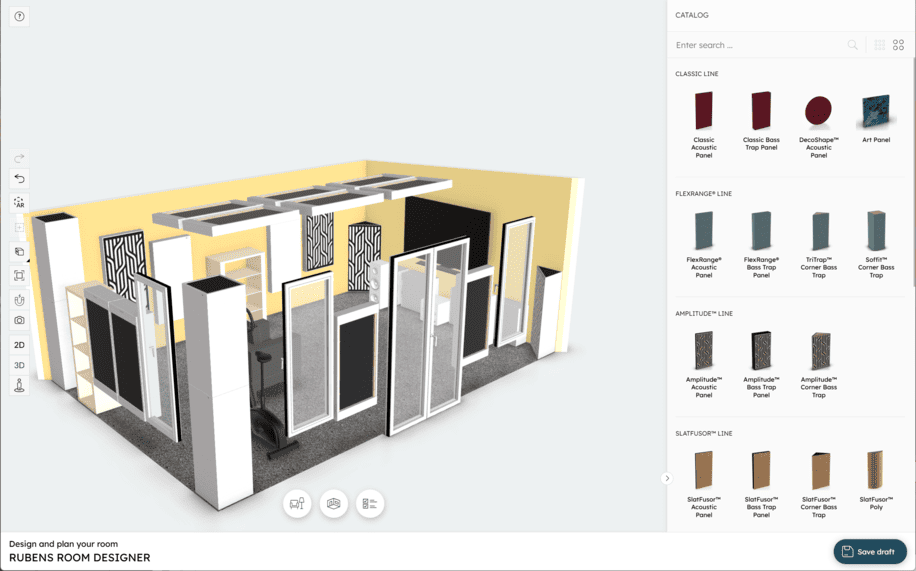
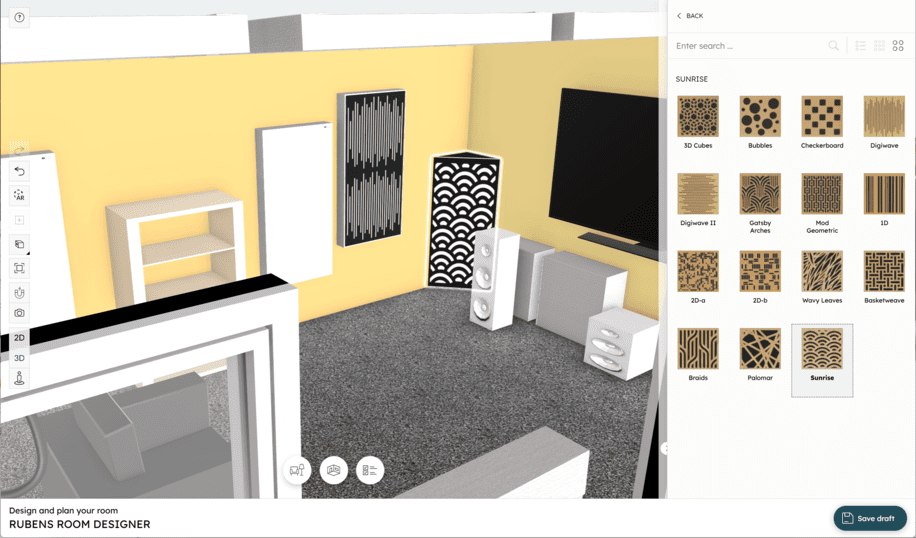
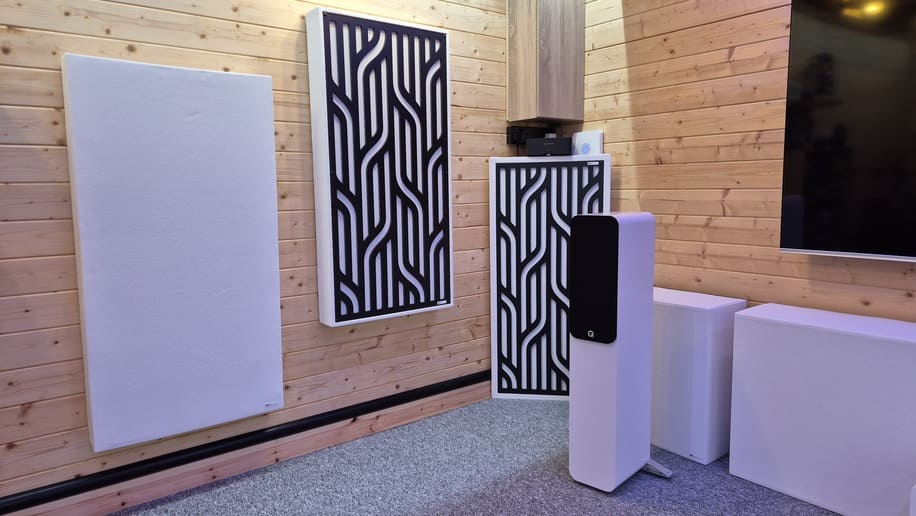
One of the more useful and indeed fun aspects of GIK’s workflow is the visual modelling. Using the web-based design software, Paul generated a virtual layout mapping out the proposed treatment solution and showing exactly where each panel would sit. You then play about with fabric colours, diffuser panel designs and finishes and custom sizing to show the customer exactly how the finished room will look.
There is a lot of choice. The Amplitude panel range, for example, is available in four standard sizes, with 20 fabric finish options, 12 different fretwork designs for the front panel in five different finishes. That is 4,800 variations! Given acoustic treatment’s historical bad rep for being ‘foam egg-boxes stuck on the wall’, the room modelling software is a great sales tool for customers.
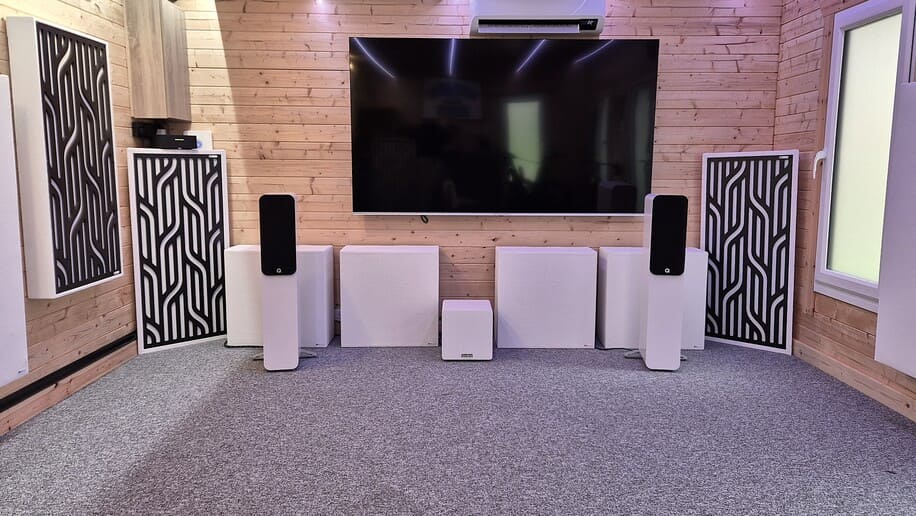
I had initially chosen one of the many shades of grey fabric to blend with the room carpet but decided that looked a bit ‘meh’ in the room designer software. A rabbit-hole of options and room designs ensued, culminating in a red and black suite that in the cold light of day I realised had all the ambience of a high-class brothel. An equally impactful but more sophisticated monochrome white and black design was the final design.
Specification
GIK’s methodology is built on sound science and a skim through its website demonstrates the depth of expertise, complete with charts of attenuation by frequency response of every product in the range. Throwing up a few random panels to tame a lively room, this is not. For integrators and installers, using GIK to spec the room treatment is one less complex system to learn.
The final specification at the Chez Stevenson Music Cabin came in at around £5,000 retail including VAT, and comprised 24 individual elements. (See box for details). Wall mounted units are supplied with simple Z-clips but you may need some creative support for the freestanding units if the floor is anything but plumb-level. Ceiling units are supplied with eyelets and heavy hanging wire.
With one of the rigid Bass Corner Traps getting evicted for not quite fitting inside the rafter, the overall GIK treatment install was very easy. My wooden walls helped speed things up as no drilling or wall-plugs were required and it took less than half a day. A fair chunk of that was clearing up the mountain of cardboard packing.
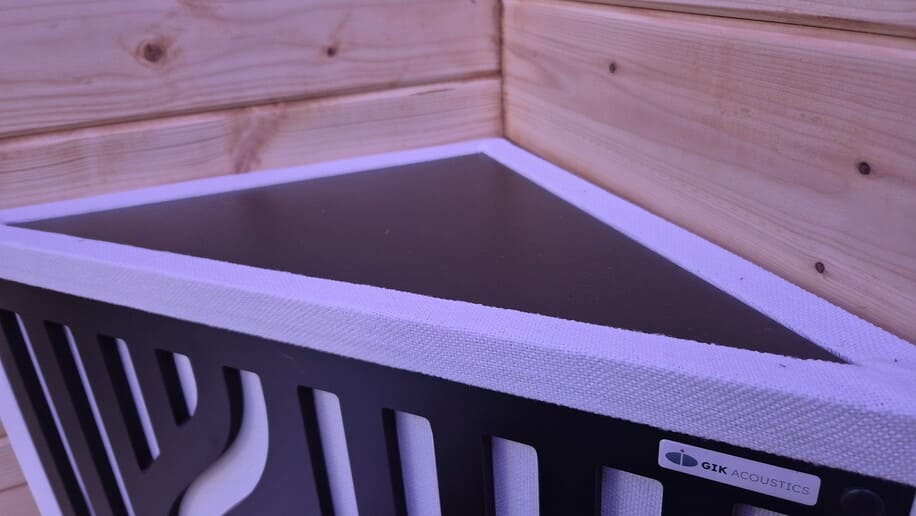
The panels themselves are very nicely made fabric over substantial plywood frames and various thickness and densities of acoustic foam within. Fabric around the corner section uses neat glued folds and the fretwork wood diffuser panels on the Amplitude models are now recessed into a fabric frame. Older models I used in the cinema project had the diffuser panels simply bolted to the front, so this is a step up in cosmetics. The corner Amplitude panels and Soffit Corners also add a sophisticated looking wooden top panel.
The white fabric might not have been the best choice for the long haul given its ability to highlight dirt and marks, and I found OCD-level hand washing prior to handling is a must. The white also highlight any ‘push marks’ in the fabric far more than my black or grey panels. Use extreme care when moving them about as I managed to put a semi-permanent ‘dent’ in the fabric of a SoundBlock by sticking the corner of another panel into it. Probably should have gone with brothel-red.
Of course, if a fabric wall is all part of the overall room design, then the panels can be placed behind it and the colour isn’t even a question.
Results
The night/day change of adding GIK treatment to the cinema room was not as pronounced in the cabin but initial impressions, even with the budget audio system currently in situ, were good. The room’s familiar bass bloom had all but disappeared, replaced by a leaner, tighter low end. At higher volumes the system felt a little more revealing and less forgiving, but like such upgrades in component choice, this was a classic ‘grower’.
Previously dominant room modes receded, allowing bass to resolve into distinct notes rather than a broad, lingering thump. Kick drums gained precision, stopping and starting with intent. The midrange opened up too, with vocals locking more firmly into place and instrumental textures emerging from what had previously been a gentle blur. Subtle details, harmonics, decay, spatial cues, all stepped forward. Now, I can hit an indoor bike session in the music room playing Progressive Techno over 100dB with the best of them and I would go untreated room-enhanced LF for that. Yet for true critical listening (rather essential for a reviewer), the results were spot on.
Crucially, the room didn’t sound dead. Diffusion elements preserved energy and air, maintaining a sense of liveliness while removing the chaos. GIK’s own research points to the same conclusion: untreated rooms exaggerate some frequencies while masking others. By controlling modal ringing and early reflections, the system is allowed to perform closer to its intended response. The result here was less immediate ‘wow’, but far greater long-term accuracy and listenability.
For installers, that shift is where the opportunity lies. Acoustic treatment addresses one of the most common causes of underwhelming system performance: the room itself. It also introduces a clear, tangible revenue stream, with physical products that can be specified, supplied and installed as part of the wider project. Working with GIK on that simply removes much of the complexity.
After all, once you hear what a properly treated room can do, it becomes difficult to go back. And that, ultimately, may be GIK’s most persuasive sales tool for the CI trade.
The Treatment Plan
REAR WALL: 4 x Soffit Corner Bass Traps; 2 x Amplitude Bass Trap Panels tuned to 60Hz
FRONT WALL: 4 x SoundBlocks full range; 2 x Amplitude Corner Bass Traps
SIDE WALLS: 4 x FlexRange Bass Trap Panels full range; 2 x Amplitude Bass Trap Panels tuned to 100Hz
CEILING: 4 x FlexRange Bass Trap Panels full range; 2 x FlexRange Bass Trap Panels full range with scatter pate (rear)