

 Lewis Caliburn
Bitdefender, a global cybersecurity leader, has released joint research with NETGEAR titled the 2026 IoT Security Landscape Report, an in-depth look at how threats to connected homes are evolving.
The research details how the growing Internet of Things (IoT) ecosystem, from smart TVs and streaming boxes to routers and cameras, has expanded consumer exposure to automated cyberattacks and large-scale exploitation. It also finds that these devices are now more than targets, serving as proxies, sensors, and footholds inside the home.
“The increase in connected devices has turned homes into complex digital ecosystems, and every addition gives attackers another doorway in,” says Ciprian Istrate, Senior Vice President of Operations at Bitdefender Consumer Solutions Group. “Cybercriminals are using AI to speed attacks on newly discovered vulnerabilities from days to a matter of hours, putting families at far greater risk. Our research with NETGEAR shows that router-level protection is now critical for defending against malware, identity theft, and increasingly sophisticated scams.”
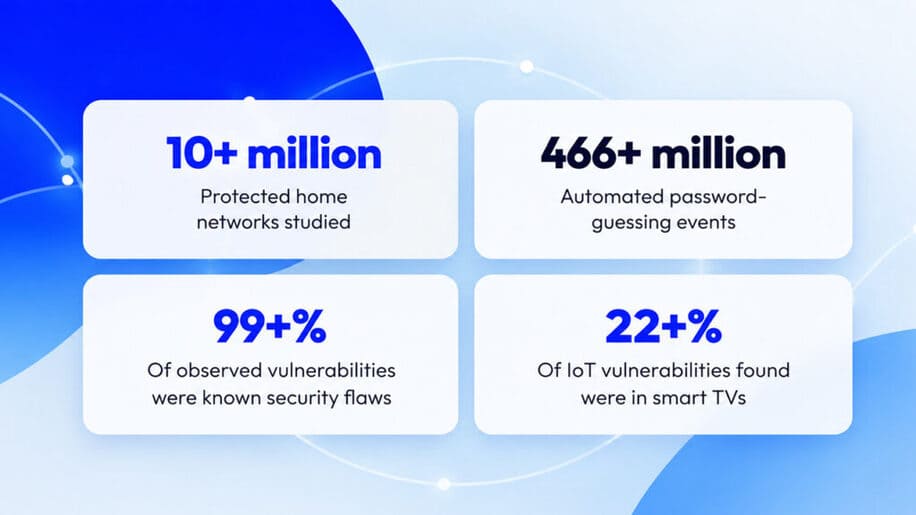
The 2026 IoT Security Landscape Report draws on telemetry from roughly 10.4 million smart homes globally, collected from January through September 2026. Bitdefender researchers analysed 5.4 billion security events and 1.2 billion vulnerability observations.
The report also examines the year’s landmark incidents, including the dismantling of four IoT botnets by the U.S. Department of Justice and the discovery of proxy software bundled into smart TV apps, which can turn televisions into relays for third-party traffic.
Smart TVs top connected device vulnerability findings
Key findings from the 2026 IoT Security Landscape Report include that one vulnerable device can present four attack opportunities: it can be targeted directly, act as a proxy relaying third-party traffic, gather information as a sensor, or provide a foothold into the wider network.
Smart TVs, where all four roles converge, led all categories with 270.3 million vulnerability observations, demonstrating how an ordinary product can create risks beyond itself.
The average household now has 24 connected devices, up from 22 last year, while reconnaissance accounted for 90.1% of detected attack activity. Automated scans identify weakly secured networks and devices for larger attacks or botnet recruitment.
Smart TVs (22.7%), smart plugs (22.4%) and network-attached storage (22%) account for 67.1% of vulnerability observations. In 2025, streaming devices (25.9%) and smart TVs (21.3%) led the list. The findings indicate that long-lived devices, which are rarely replaced and often remain online beyond their update and support windows, carry the greatest vulnerability burden.
Known IoT vulnerabilities highlight the need for security updates
Nearly all observed device vulnerabilities are publicly known, with flaws catalogued as Common Vulnerabilities and Exposures (CVEs) accounting for 99.97% of the total. Weak passwords and plaintext authentication account for a fraction of one per cent. This finding reinforces the need for timely patching and better device management.
Mobile phones account for 20.4% of the devices identified on home networks, making them the most common connected device type. They are followed by TVs (10.6%), computers (10.0%), network equipment (6.2%) and streaming devices (5.4%), down from 7.3% in 2025. Tablets (4.8%) and IP cameras (4.1%) follow.
Memory errors and denial-of-service risks in connected devices
Overflow errors account for approximately 54% of potential attack outcomes, followed by denial-of-service (about 18%) and memory corruption (about 17%). These figures point to weaknesses in memory safety and input validation in device software. The most serious outcomes, which give attackers control of a device or its data, are far less common. Privilege escalation accounts for 5.3%, code execution for 3.8% and obtaining information for 1.2%, representing approximately 10.3% combined.
NETGEAR and Bitdefender focus on connected home protection
“A connected home depends on more than speed, coverage and reliability. It also depends on the visibility and protection that services such as NETGEAR Armor powered by Bitdefender bring to activity across the network, plus security at the router level,” says Chandan Nandakumaraiah, Head of Product and Cybersecurity at NETGEAR and member of the CVE Board.
“As enterprises get better at protecting their digital infrastructure, cybercriminals are turning to connected home devices. These devices are increasingly smart and powerful, which makes them an ideal foothold: always on, reliable, and rarely monitored. Once inside, criminals can stay hidden and move laterally across the home network. Monitoring, detecting, and blocking these threats is more important than ever.”
Bitdefender and NETGEAR continue to address these challenges through NETGEAR Armor powered by Bitdefender, a built-in security platform available on NETGEAR’s Nighthawk routers and Orbi Mesh WiFi systems. Armor helps detect and block known and emerging threats, identify vulnerabilities and safeguard users against phishing, data theft and other attacks.
To download a copy of the full 2026 IoT Security Landscape Report, click here.