
 Staff
StaffAs buildings become increasingly intelligent and interconnected, distributed audio is evolving from a standalone AV system into an integral part of the smart building ecosystem. AmpVortex, explains its place in this new landscape.
For more than 35 years, KNX has been the world’s leading open standard for smart home and building automation, built on a simple principle: open interoperability.
Lighting, HVAC, shading, security and energy management can communicate within a common ecosystem. Yet one important technology often remains separate: distributed audio.
In many projects, audio relies on controllers or gateways to communicate with building automation. This enables basic volume, mute and source control, but smart buildings require deeper integration.
Why Native KNX Audio Matters
Audio is increasingly part of the overall building experience.
In luxury residences, music should work alongside lighting, climate, shading and occupancy. In hotels, guests expect effortless streaming, while operators need managed music across lobbies, restaurants, bars, spas and public areas. Commercial buildings have similar needs across offices and retail environments.
Native KNX integration allows audio to become part of this ecosystem rather than an isolated AV subsystem.
Instead of using external gateways, the audio platform communicates directly with KNX, enabling real-time, two-way communication including:
- Volume, mute and source control
- Playback and zone status
- Track and artist metadata
- Album information
- Automation triggers and event feedback
This enables much richer automation.
A hotel Welcome scene could coordinate lighting, climate and audio simultaneously. A restaurant opening sequence could similarly activate lighting, HVAC and background music.
Why AmpVortex?
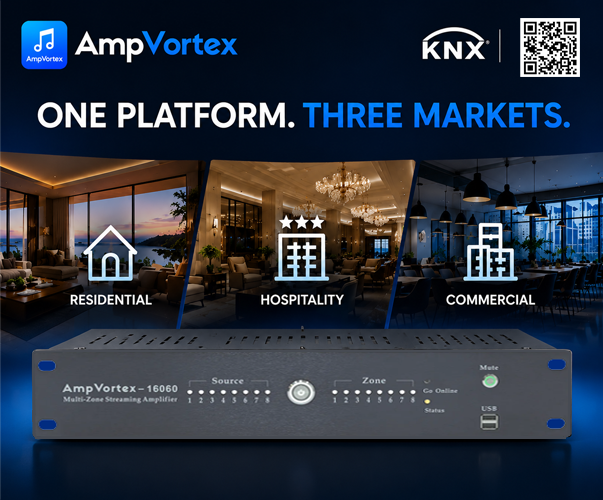
Unlike traditional standalone amplifiers, AmpVortex was developed as an open streaming audio platform for intelligent buildings.
Streaming, DSP, routing, amplification and automation are integrated into a unified architecture, reducing the need for separate devices and gateways.
The platform provides:
- Native KNX integration with real-time, two-way communication
- Eight independent AirPlay 2 streams
- Eight independent Google Cast streams
- Native Spotify Connect
- Built-in DSP, routing and scheduling
- 4Ω/8Ω and 70V/100V loudspeaker support
- Control4, RTI, Home Assistant and open Web API integration
- SoundMachine, Soundtrack and Musicstyling support
The same architecture can therefore serve premium residences, hotel guest rooms and villas, hospitality public areas, offices, retail and other commercial environments.
For KNX integrators, the benefits are clear: fewer components, simpler architecture, faster commissioning and greater flexibility.
Smart buildings are defined by how effectively their technologies work together.
Distributed audio should not sit beside the smart building. It should belong within it.