

 Daniel J Sait
Adam Bootle, Market Development Manager for Collaboration & Conferencing at Shure, explains why audio and video now matter more than ever.

Few would argue that collaboration platforms such as Microsoft Teams and Zoom have not been a success. They have transformed the way organisations communicate, making geography largely irrelevant, normalising video meetings, opening hybrid working to millions of people and enabling collaboration to become a continuous part of the working day.
So why are we still hearing that meeting rooms are ‘not fit for purpose’, or debating whether ‘good enough’ really is good enough?
The answer lies in how dramatically the workplace has evolved.
What began as a rapid shift towards hybrid working has matured into a far more sophisticated environment, where organisations are rethinking how people, spaces and technology come together to support productivity. As expectations have changed, so too has the role of collaboration technology.
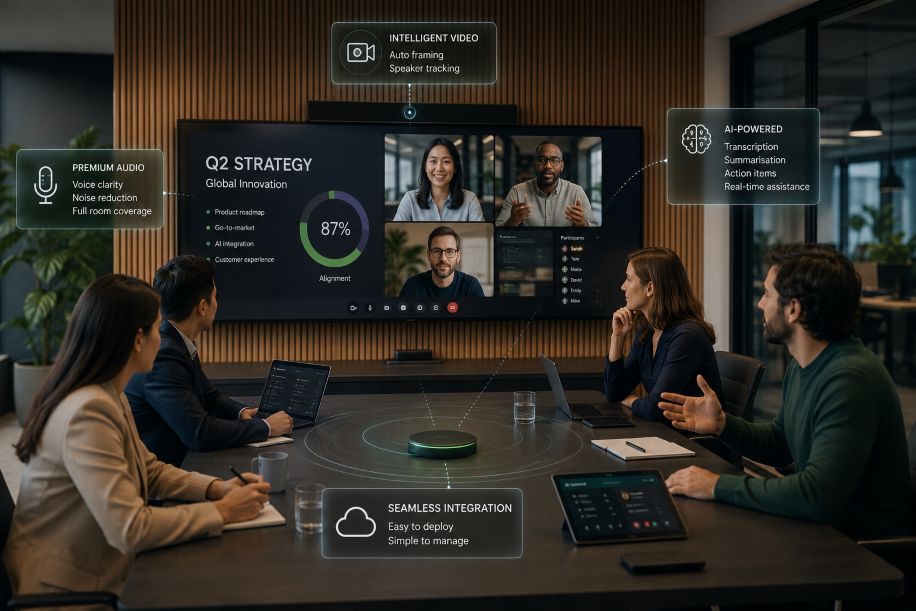
Today’s meeting rooms are no longer simply places to hold video calls. They are becoming intelligent collaboration hubs, designed to support in-room participants, remote colleagues and, increasingly, AI-powered assistants working alongside them. As a result, expectations around performance, reliability and system integration have increased significantly.
A major driver behind this shift is the rapid adoption of AI within the workplace. Capabilities such as live transcription, automated meeting summaries and real-time assistance are now embedded into leading collaboration platforms. More importantly, we are entering a new phase where collaboration is no longer solely human-to-human, but also human-to-agent and even agent-to-agent. That evolution has important implications for how meeting spaces are designed, equipped and specified.
For AI to deliver meaningful value, it depends entirely on the quality of the information it receives. Audio and video have become the foundation on which AI understands context, captures intent and generates accurate outputs. If the audio is poor, transcriptions become unreliable and summaries lose their value. If the video is inconsistent, participant framing, speaker tracking and recognition all suffer. Put simply, compromised inputs lead to compromised AI.
This is where high-performance collaboration technology becomes essential. Advanced microphone arrays, intelligent audio processing and carefully designed camera systems ensure that every participant is seen clearly and heard accurately. Equally important are technologies that minimise background noise, adapt to challenging room acoustics and provide consistent audio coverage throughout the space. These are no longer desirable extras but fundamental requirements for modern collaboration.
At Shure, we are seeing growing demand for integrated solutions that combine audio, video and processing into systems that are straightforward to deploy and manage while still delivering the performance organisations expect. That reflects a wider trend across the market. Businesses are looking for simplicity and ease of use, but they are no longer prepared to compromise on quality to achieve it.
Ultimately, the organisations that will gain the greatest benefit from collaboration technology are those that view it as a strategic business function rather than simply an IT requirement. Technology undoubtedly plays a central role, but only when it is implemented with a clear understanding of how people work today and how those workflows will continue to evolve.
As the workplace enters the next phase of AI-driven collaboration, one principle remains unchanged: clear communication is the foundation of every successful meeting. Ensuring that every participant, whether human or AI, can accurately capture, interpret and contribute to the conversation will define the next generation of collaborative experiences.