
 Daniel J Sait
Steven Cogels, Global Director of Business Development, PlexusAV, examines how to achieve true AV interoperability.

Interoperability has long been one of the biggest promises of IP-based AV. The idea is simple: products from different manufacturers should work together over a standard IP network, giving integrators and end users the freedom to choose the technology that best meets their needs without being locked into a single proprietary ecosystem.
However, there is a difference between a standard being specified and one being proven in practice. In 2026, IPMX (IP Media Experience) has taken an important step towards making that promise a reality.
Officially launched as a fully developed, certifiable standard at ISE 2026, IPMX has moved beyond specification into certification, product development and real-world adoption.
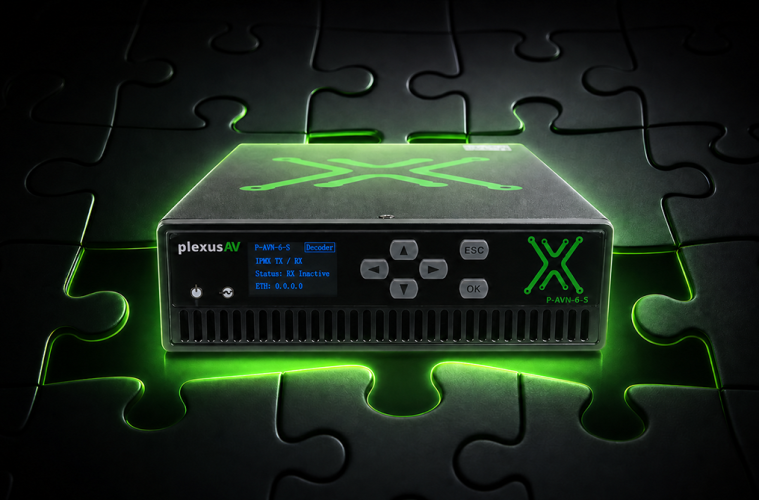
The first official IPMX Certification Test Event, held at the European Broadcasting Union (EBU) headquarters in Geneva in January, brought together 25 engineers for five days of interoperability testing. Forty-eight products from 11 manufacturers passed, including three PlexusAV product lines. A second event in August expanded testing to include security and compression. Of the many products submitted by manufacturers between the two events, 62 achieved certification, including PlexusAV’s P-AVN-6 and P-AVN-4.
These milestones matter because certification provides something the AV industry has historically lacked: greater confidence that products from different manufacturers will work together as intended.
From broadcast to everyday AV
IPMX has naturally attracted attention from the broadcast and professional AV communities, particularly given the convergence between these two sectors. However, its potential extends well beyond broadcast applications.
Some of the first pro-AV-centric IPMX deployments are now emerging in corporate and higher education environments, particularly for video distribution.
For integrators, this opens up opportunities to design more flexible, scalable systems using products from different manufacturers. Rather than committing to a proprietary architecture, they can build infrastructure around the specific requirements of each project.
This is particularly relevant for organisations where technology needs to evolve alongside changing spaces, users and workflows. An open IP-based approach provides a platform that can adapt rather than a fixed ecosystem that may become restrictive as requirements change.
Reducing vendor lock-in
The wider ambition of IPMX is to create an interoperable environment in which integrators can select best-of-breed components rather than having to source an entire solution from one manufacturer.
With more than 70 organisations involved in the wider Alliance for IP Media Solutions (AIMS) ecosystem, the industry is working towards a common approach that encourages collaboration rather than proprietary boundaries.
For end users, this can offer greater protection for technology investments. Individual components can potentially be upgraded or replaced without having to redesign an entire system around a particular manufacturer’s ecosystem.
The conversation therefore changes from which technology platform an organisation must buy into to which products best solve its individual challenges.
A more sustainable approach
Interoperability also has implications for sustainability. More open and adaptable infrastructure can help reduce reliance on proprietary appliances, make better use of existing network infrastructure and extend hardware lifecycles.
Intelligent power management offers another opportunity. A recent deployment at Loughborough University’s STEM Labs demonstrates what can be achieved through smarter AV system design.
Across 93 networked AV devices (P-AVN-4 IPMX transceivers), reducing power consumption outside teaching hours was calculated to deliver an estimated 40% reduction in energy consumption and annual operating costs. Over five years, the approach is projected to save approximately 42,664 kWh of electricity, £10,960 in energy costs and 8.83 tonnes of CO₂ emissions.
This demonstrates that energy efficiency does not have to come at the expense of functionality. Designing systems around actual usage patterns can make sustainability an integral part of AV infrastructure rather than an afterthought.
Turning potential into practice
IPMX is still evolving, with capabilities such as advanced security and compression continuing to develop. Integrators should assess the maturity of individual features against their project requirements and engage with manufacturers about current product capabilities and roadmaps.
Nevertheless, the progress made during 2026 is significant. Certification is building confidence, manufacturers are developing products and early deployments are demonstrating the potential of an open approach to AV.
Ultimately, the success of IPMX will not be measured by how often the industry talks about interoperability. It will be measured by whether integrators can select the right products for a customer, combine equipment from different manufacturers and have confidence that it will work together.
That is when interoperability stops being a promise and becomes standard practice.