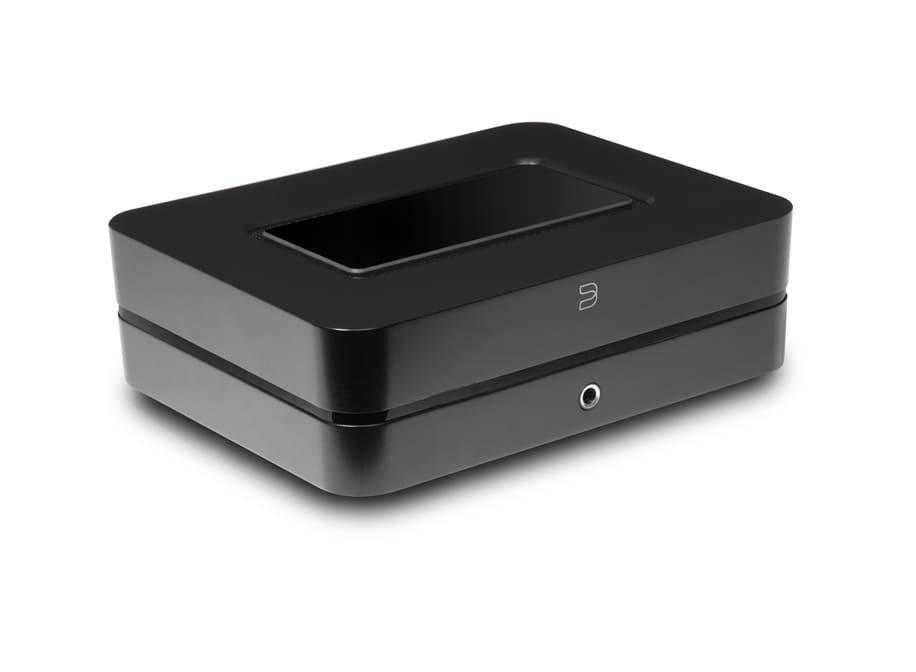

Bluesound’s PowerNode 2025 marks a decade of evolution across four generations that this year sees it dipping its transistors into AV waters. Does our intrepid reviewer Richard Stevenson fall under its power?
From its debut over a decade ago, the original PowerNode married NAD’s proven HybridDigital amplification with BluOS multi-room streaming in a minimalist chassis. It was part of a quiet revolution in ‘all-in-one’ streamer amps. That category is now a huge part of the audio market, across residential and install. Can the unique features of the 2025 PowerNode kickstart another trend?
As a bit of history, the PowerNode 2 brought tangible refinement over the original, with higher-grade DAC stages, quieter internals and an upgraded power supply. Something of a mid-cycle upgrade, the later 2i revision marked Bluesound’s added AirPlay 2, two-way aptX HD Bluetooth and HDMI ARC. That turned what was once a simple streamer-amp into a credible TV audio hub.
The 2021 PowerNode, often referred to as the third generation, re-engineered the architecture around a new quad-core 1.8 GHz ARM processor, increased the amplifier output to 80W per channel and overhauled the DAC and DSP paths for noticeably greater transparency. Touch-panel control, proximity sensors and faster BluOS added extra pizazz to the genre.
Fast-forward to 2025 and the fourth-generation PowerNode turns the volume up to 11 on features and performance. Alongside a raft of audio tweaks, it lifts output again to 100W × 2, competing spec-to-spec with the potent Marantz M1. Perhaps most unusually, however, is the inclusion of a discrete third amplifier channel for LCR or 3.1 operation, onboard Dolby Digital processing and the option of wireless rear channels for 5.1.
That is quite the leap into AV from a simple HDMI eARC connection and I suspect it may polarise some opinions. Does it turn the PowerNode into a serious contender for filling the gap between top-end soundbars and a full AVR set-up, or is it adding the cost of a third-channel amplifier and Dolby-licensed processing that two-channel die-hards will never need?
For customers raising an eyebrow about the latter, the 2025 model also integrates THX AAA spec headphone amplification and lowers distortion across the board, offering arguably even higher stereo music chops than its dedicated two-channel forebear.
A win?
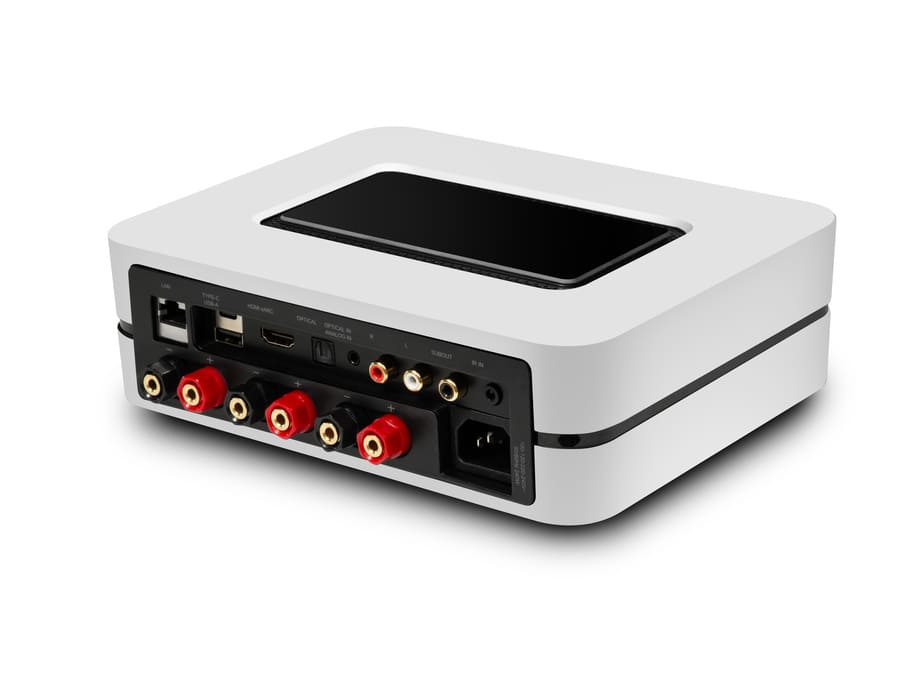
For the CI market, it could be a big win. The headline change is architectural: the amp platform now delivers 100W × 2 into 8Ω in stereo or 80W × 3 in LCR mode, with a dedicated third set of binding posts for a passive centre and the option of wireless rears. Add the cost of a pair of Bluesound Pulse Flex speakers, and you can build a credible plug-and-play 5.1 system from the PowerNode that still performs at the top of the game in sub-£1000 stereo all-in-one amplified streamers.
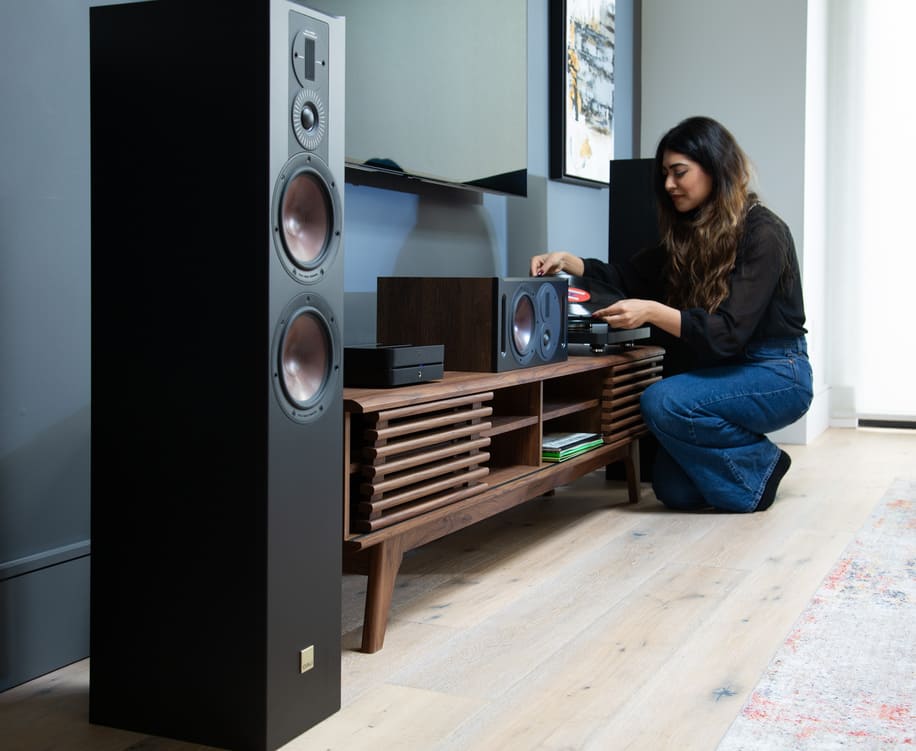
Better still, two fit perfectly side-by-side on a rack shelf or a 2U tall rack mount, or one will slip down the back of any TV with a suitable mount, and the Bluesound ecosystem works with possibly the widest range of integrations of any similar products. Crestron, C4, RTI, URC, Lutron and even Amazon Alexa get the gig. Add in Apple AirPlay 2, Spotify and Tidal Connect, Roon Ready, aptX Bluetooth and connection over WiFi or RJ45, and the installer boxes are well and truly ticked.
The wireless rears operate on a direct connection with the PowerNode, called Bluesound Bonded Speaker Link. The system uses its own point-to-point WiFi LAN from the PowerNode, taking the pressure off the home network and keeping the sync tight. Moreover, using WiFi rather than a less ‘rangy’ wireless protocol like Bluetooth means there is little danger of the Bonded Speaker Link’s reach, from a PowerNode in a central rack, failing to reach all but the farthest rooms in large houses. What a fabulously elegant solution.
Connectivity has also had something of a cabinet reshuffle, which now includes USB-C, full-size optical and RCA line-level inputs, and a ‘proper’ 6.3 mm headphone jack on the front for the THX AAA output. The output can be two, three or five channels, with an optional hardwired subwoofer output for .1 duties. It is stoically vanilla Dolby Digital rather than fully featured with Atmos, DTS or Auro, but as almost all content – broadcast, streamed or on disc – defaults to DD, and that keeps things very neat.
The good stuff
Not enough goodness for one sub-£1000 package? Well, Dirac Live room EQ is coming to a PowerNode near you soon too. There is something to be said for a 10-year strategy of constant product evolution; precious little gets left on the drawing board.
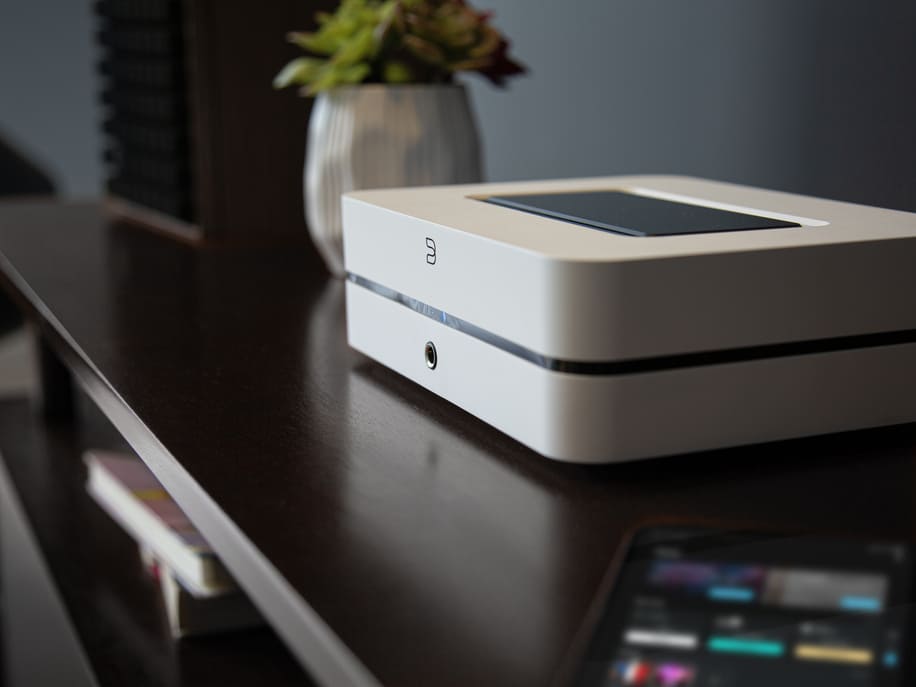
Out of the box, the form factor is not massively changed, save for the large mirror-like acrylic touch panel on top. This has a proximity sensor that lights up as your hand nears. There are basic volume adjustment and power controls here, as well as five configurable presets for different sources and set-ups. The panel shows up fingerprints like a CSI team, and I suspect constant buffing may leave micro-scratches over time. Given the superb BluOS app and Spotify/Tidal Connect, the buttons are probably going to take a back seat most of the time anyway.
Set up involves powering on, opening the app, adding a WiFi password and naming the room, and, well, that is it. It is seamless. Sonically, it is just as crisp, detailed and potent as its predecessors, which I have dotted around the house. Perhaps a little more detail, a little more ‘HiFi’ than ‘rave party’ compared to the likes of the Marantz M1 and an eminently sophisticated sound throughout.
I confess coming to the new PowerNode feeling that the added AV-ness may be about to stymie what has been one of my favourite two-channel product series of the last decade. Not so. The 2025 PowerNode retains all the series’ essence in a fully featured two-channel audiophile-quality amp/streamer and simply adds a heap of flexibility in moving it gently into AV and multichannel music – if required.
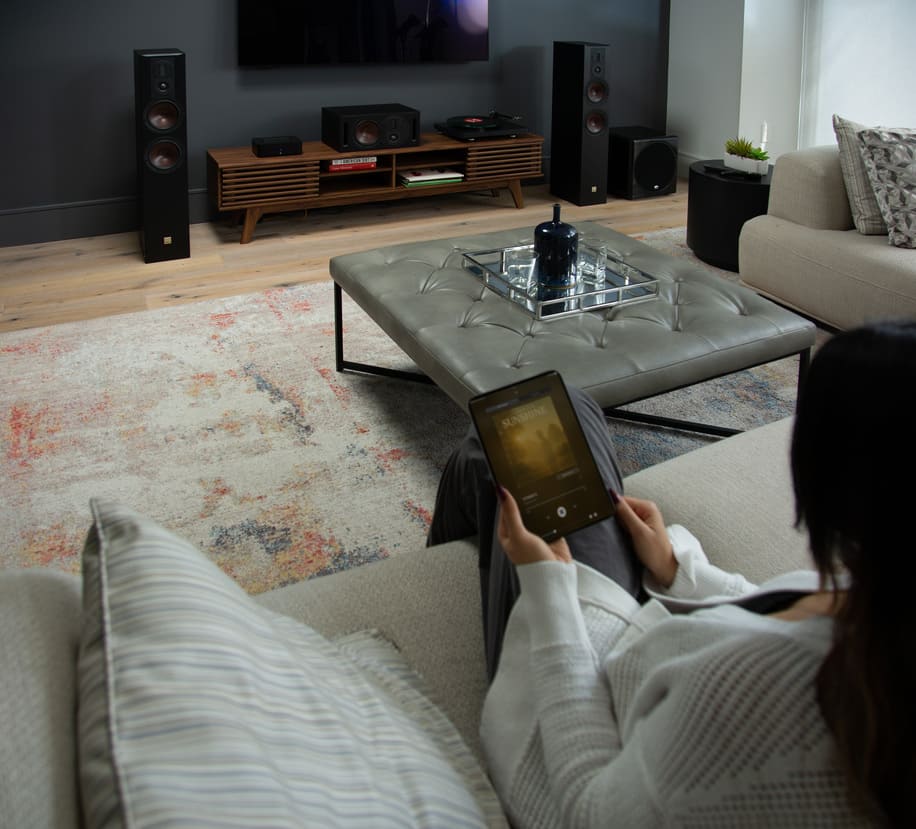
The design, spec sheet, implementation and the new features allow the PowerNode to take back its crown as the premier amp/ streamer under £1000, and bring with it unrivalled flexibility for installers and end users alike. Other than the simple one-box simplicity of a high-end soundbar, the PowerNode, good stereo speakers and a matching centre speaker could trounce a soundbar performance in all but surround ambience and fancy Atmos effects.
Just to ice that cake, adding a sub (of any brand, no tie-ins… I am looking at you, Sonos) and a pair of Bluesound Pulse rears gives you a significant trade-up opportunity to create a capable AV system for a music-centric customer without the added complexity of an AVR. The 2025 PowerNode is a rather genius product development all around.