




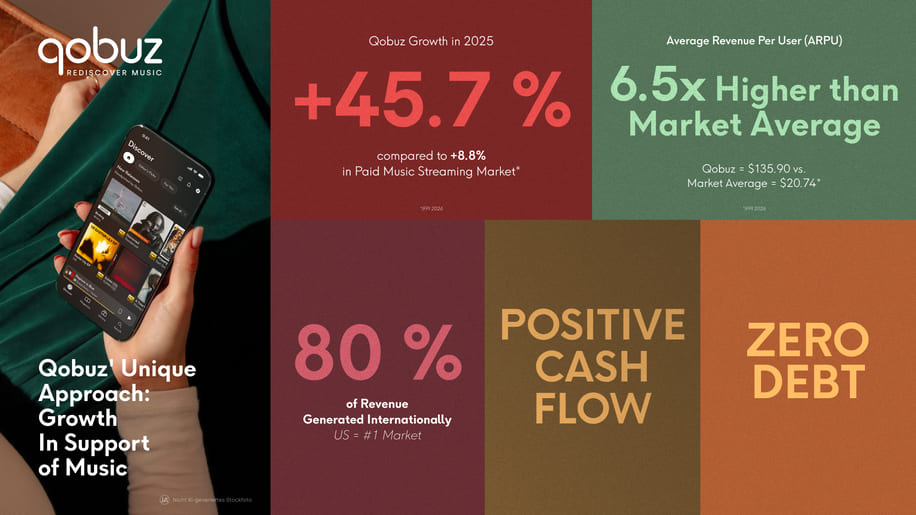

Qobuz has reported revenue growth of 45.7% in 2025, significantly outperforming the global paid music streaming market, which grows by 8.8% over the same period.
The high-quality music streaming and download platform says its continued expansion is being driven by strong international performance, with 80% of revenue now generated outside France.
The company says the United States is now its largest market, while the UK continues to emerge as a key growth territory, accounting for 10% of global revenue and growing by 37.6% year-on-year.
Key Figures
● 45.7% growth in 2025 in a paid streaming market worth $16.6bn, growing by 8.8%
● 80% of revenue generated from international markets, with the United States as Qobuz’s largest market
● UK: 10% of revenue, 37.6% year-on-year growth
● Average Revenue Per User (ARPU): more than 6.5 times the market average — $135.90 versus $20.74
● Positive free cash flow and zero financial debt
A growing market, driven by the paid subscription model
In 2025, the global recorded music market reaches $31.7bn, with streaming accounting for 69.6% of total revenue and continuing to drive the sector’s growth, says the company. Within streaming, the paid subscription model leads with growth of 8.8%, concentrating value creation among engaged, paying listeners.
Qobuz says it has operated exclusively within the paid subscription segment since launch and delivers revenue growth of 45.7% in 2025, more than five times the market rate. The company announced 1.2 million monthly active users in May 2026.
The success story of an independent company that has gone global
Founded in 2007 and owned since 2015 by a private, primarily French family-owned group, Qobuz says it has established itself as a global player.
● An international business. The company says 80% of revenue is generated from international markets. The United States is now its largest market ahead of France. Present in 26 countries, including Japan since October 2024, Qobuz says it continues its global expansion.
● A clear path to profitability. Qobuz reports positive free cash flow, zero financial debt, EBITDA break-even under IFRS and a positive net result expected by March 2027.
● Revenue per user more than 6.5 times the market average. The company says a Qobuz subscriber generates average annual revenue of $135.90, compared with a market average of $20.74.
The company argues these results underline the strength of an independent model built on the quality of its offering and the engagement of its subscribers rather than volume alone.
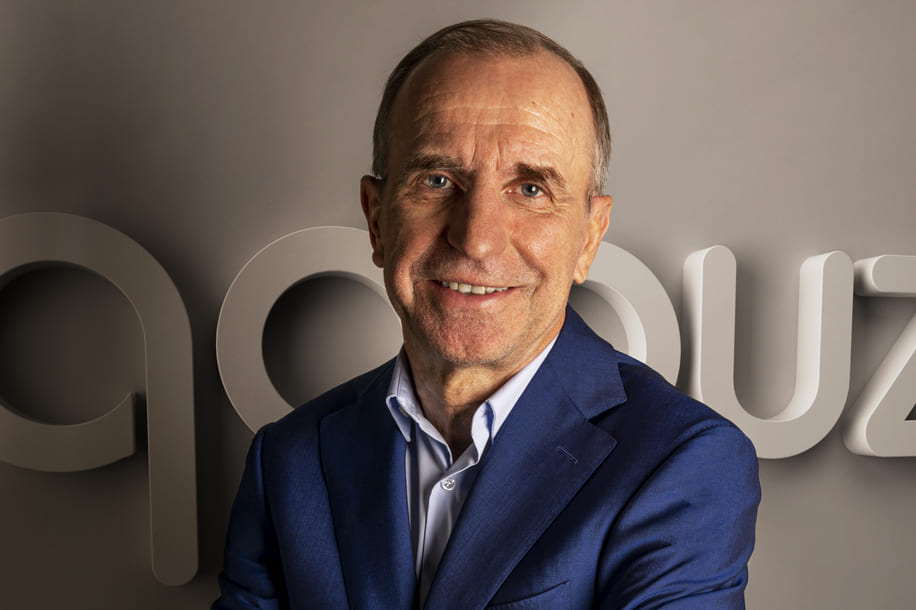
Georges Fornay, Deputy CEO, Qobuz, says, “Since the acquisition in 2015, we have chosen a structured, coherent path forward: a differentiation strategy, disciplined execution and fully committed teams. No dispersion, no public funding. This consistency is what is delivering strong, sustainable growth today.”
A standout player in a market dominated by giants
Qobuz says it has built its position by remaining focused on its founding principles of supporting music, artists and listeners.
The company highlights several long-standing commitments:
● An exclusively paid subscription model with no in-platform advertising
● High-resolution audio quality designed to remain faithful to the original recording
● The only platform combining streaming and à la carte Hi-Res downloads, alongside editorial content created by journalists and music experts
● A fully human-curated approach to music discovery and recommendation
● Employee ownership, with the company stating that all employees are shareholders
The company also points to what it describes as a unique level of transparency around royalty payments. In March 2025, Qobuz became the first streaming platform to publicly disclose its average per-stream royalty rate, which the company says was independently validated at $0.01873 per stream for fiscal year 2024, equivalent to $18.73 per 1,000 streams paid to rights holders.
An independent platform built for the long term
Qobuz says its performance demonstrates that specialist music services can compete successfully in a market often dominated by much larger technology companies.
Fornay says, “Our conviction has never changed: music at the heart of everything, by humans, for humans. That is what drives every decision at Qobuz, and our results show that this conviction is also a viable business model.”
He adds, “Music streaming is a vast market. We have chosen to build our place within it on our own terms: premium, independent, in service of artists and music lovers. That journey is built to last.”