

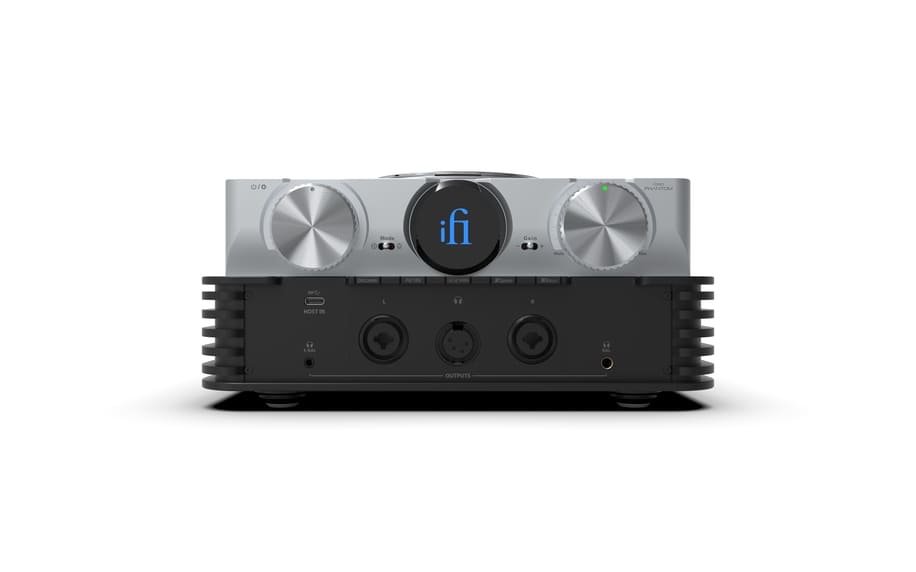
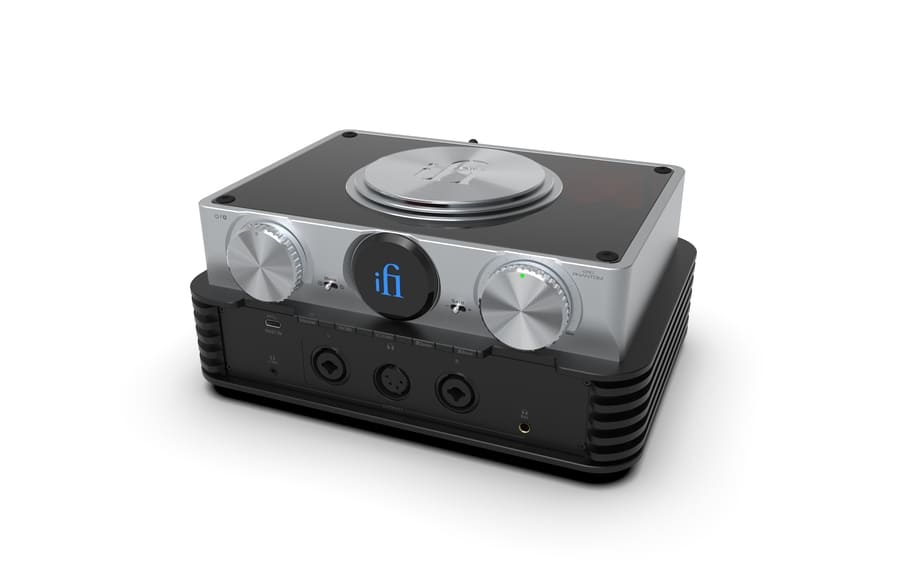





iFi audio has unveiled the iDSD PHANTOM – a new flagship home device. By uniting a reference-class DAC, ultra-resolution network streamer and headphone amplifier, the PHANTOM delivers iFi’s most accomplished listening experience to date.
Compared with the previous flagship Pro iDSD, the PHANTOM advances every core stage: a rebuilt streaming engine, higher-precision conversion, greater output headroom and more granular user-control.
Beneath its two-tone exterior lies fundamentally new circuitry alongside professional-grade technologies. DSD Remastering up to DSD2048 and K2HD Technology offer a level of sonic control once reserved for elite mastering studios, while XBass Pro, XSpace Pro, digital filters and real-time circuitry switching offer deeper levels of personalisation.
“Each stage of development involved re-examining the circuit, measuring performance, and making improvements to cement it as the most accomplished iFi listening experience to date,” says Colin Farch, Chief Engineer, iFi audio.

The iDSD PHANTOM debuts the latest evolution of iFi’s ultra-resolution streaming engine, adding Qobuz Connect alongside Tidal and Spotify Connect and AirPlay 2. This next-generation platform brings a wealth of refinements, including enhanced stability, smoother web radio performance and a more intuitive interface with advanced settings for customisation.
The result is an all-in-one audio centrepiece designed to serve as the heart of a home setup, underpinned by a network streaming experience that incorporates native 768kHz PCM and DSD512 support. The PHANTOM unlocks your library across a user’s home, allowing management and access to ultra-res digital audio from external hard drives and NAS drives.
To preserve signal purity, the PHANTOM incorporates galvanic isolation on its Ethernet, S/PDIF and AES/EBU inputs, separating it from sources at a circuit level to block electrical noise while allowing audio data to pass unimpeded. For further refinement, the PHANTOM offers iFi’s Exclusive Modes, which shut down unused system processes when streaming to improve operating efficiency and reduce the potential for signal noise.
Meanwhile, the iFi Nexis companion app has also evolved to support Wi-Fi linking, making it easier than ever to connect and queue music to the PHANTOM from anywhere in a home.
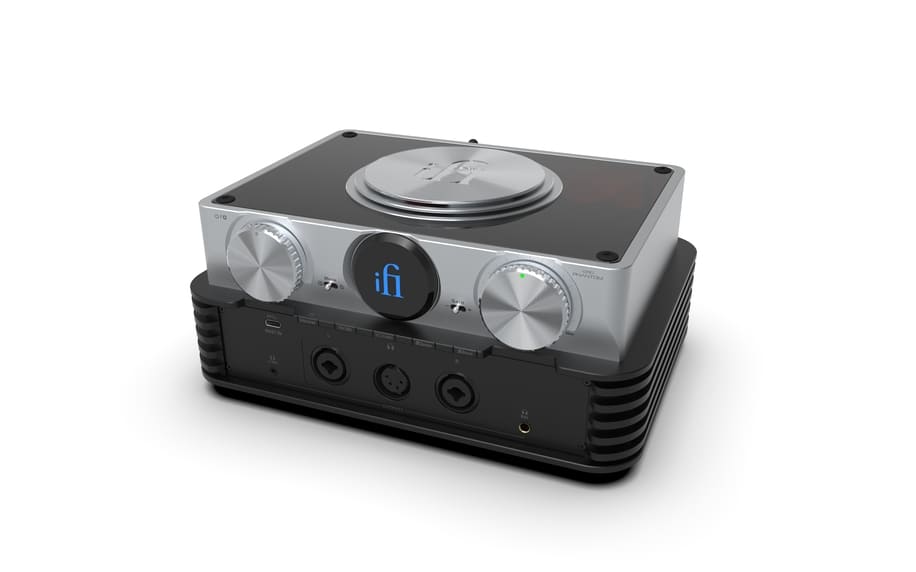
Native DSD excels at low-level resolution and time-domain behaviour; this philosophy has driven iFi’s previous successes in DSD Remastering technology and they have recommitted to this by reworking and further customising this technology at every step of the signal’s journey through the conversion process.
iFi’s Chrysopoeia FPGA-based Remastering Engine brings studio-grade DSD2048 conversion into the living room. iFi uses this FPGA to apply proprietary remastering algorithms and reduce jitter, ensuring the DSD signal is clean, stable and precisely timed before it reaches the conversion stage.
The DSD bitstream is then directly converted to analogue using the same delta-sigma modulator that would be used in DSD recording. No digital filtering or volume control is applied to DSD – the latter is handled in the analogue domain, preserving the signal’s purity.
At the PHANTOM’s core, four Burr-Brown DSD1793 DACs operate in a custom interleaved configuration, drawing inspiration from the company’s experience with the multi-bit Philips TDA1541A. I
n ‘Normal’ mode, DSD signals pass directly to the DAC while PCM signals go through a user-selected digital filter. In ‘Remastered’ mode, each DAC chipset processes up to DSD1024 and in their custom configuration they achieve native decoding that allows for DSD512, DSD1024, or the new pinnacle of DSD2048.
The result for the listener is that DSD Remastering deepens resolution and minimises distortion through its high sample rates. At DSD2048, the 1-bit stream is sampled ~90 million times per second, pushing quantisation noise beyond the audio band for low in-band distortion.

Real-time user-selectable operation modes inside the PHANTOM deliver the experience of three DAC/amps in one. These options are provided courtesy of two entirely separate output topologies – one solid state, the other tube-based.
“We tuned the output stage to sustain a 67% higher current rating, supported by optimised voltage and current settings,” says Colin Farch, Chief Engineer, iFi audio. “This gave us greater drive with reduced distortion, resulting in power that feels effortless and sound that is more dynamic. We then carefully adjusted the GE5670 tubes, tuning their supply voltage so that the grid operates further from its contact potential current — a subtle shift that enhances linearity and overall clarity in the audio output.”
At the flick of a switch, listeners can move between a dual-mono Solid-State mode, where discrete J-FETs deliver fast precision and ultra-low distortion; a dual-mono Tube mode, where hand-matched NOS GE5670 valves provide warmth and liquid smoothness and Tube+, which reduces overall loop-gain to enhance the second harmonic by +6dB.
These modes allow listeners to shape the character of their HiFi system or can instead be paired with the iDSD PHANTOM’s 7,747mW peak headphone output.
In collaboration with JVCKENWOOD, the PHANTOM is the latest in iFi’s lineup to incorporate K2HD Technology. By restoring harmonic content lost during post-production or encoding, it is optimised to revive the depth, nuance and musicality of the original performance.
The PHANTOM offers this technology in two forms: ‘K2’ mode preserves the file’s original resolution, while ‘K2HD’ optionally upscales it to 192kHz/24-bit.
Over the years, the principle of K2 was adapted and applied to CD mastering, where high-frequency information above 22kHz is typically removed due to the 44.1kHz sampling rate and resolution is reduced 256 times when the bit depth is lowered from 24-bit to 16-bit.
The PHANTOM incorporates K2 parameters specially tuned by JVCKENWOOD for iFi, focusing on time-domain processing as opposed to frequency-domain adjustments. This approach allows for advanced high-frequency extension and minute signal (bit) extension, allowing both ‘K2’ and ‘K2HD’ modes to restore natural harmonics and overtones beyond 22kHz.

XBass Pro is a fully analogue variable shelving EQ, available in 10, 20, and 40Hz options. Ideal for restoring the impact and bass response often lost in open-back headphones, it lifts low frequencies without clouding the midrange, and the range of settings ensures that this restoration can be tailored both to the headphone itself and to the listener’s personal preference.
XSpace enhances the audio by creating a spacious sound field, adding speaker-like depth to the more two-dimensional headphone experience. Crossfeed is a generalised term frequently used for such processing; however, XSpace is not traditional Bauer/Linkwitz crossfeed, Meier enhanced crossfeed, or any of the published systems based on the same research and targets.
Instead, XSpace is its own system, derived largely from the targets set by the Ministry of Radio and TV in East Berlin and their foray into headphone/speaker replay compatibility.
XSpace Pro is iFi audio’s most advanced form of the XSpace, recreating the spaciousness of speaker playback in greater detail and with greater customisability. With 30-, 60- and 90-degree settings, listeners can choose the most natural presentation for their setup.
“At the system’s core, we implemented a new constant impedance negative feedback system. This ensures XBass Pro, XSpace Pro, and DSD Remastering work in perfect harmony. Within this design, we added a dedicated common-mode servo to the XBass section, smoothing voltage levels for seamless on/off transitions and maintaining bass consistency at higher gain levels,” says Colin Farch, Chief Engineer, iFi audio.
The iFi iDSD PHANTOM is available to purchase at ifi-audio.com and select elite dealers for £4,499/$4,499 USD/€4,695 EUR/$6,999 CAD.