
 Lewis Caliburn
The Ultamation team offers some insight into the opportunities around the Matter smart home standard.
For many residential integrators, we follow a familiar proposition: lighting, whole-house AV, a dedicated theatre room, HVAC, security and perhaps some access control. Each element is often built around a proprietary ecosystem, manufacturer-specific commissioning workflows, and hard-earned experience of what is promised versus what is possible or reliable. Matter addresses the fundamental problems of mixed ecosystems without the proprietary walled garden, and the integrators who recognise this early will have a genuine competitive advantage.
Matter is an open, royalty-free connectivity standard developed under the Connectivity Standards Alliance (CSA), with founding support from Apple, Amazon, Google and Samsung, and subsequent commitment from manufacturers including IKEA, Schneider Electric, Huawei and hundreds more. Its core promise is straightforward: a device certified for Matter works with any Matter-compatible controller, regardless of manufacturer. There are no proprietary hubs, no brand lock-in and no integration negotiation. For integrators, this translates directly into design freedom.
The real power of Matter isn’t any single device; it’s the common language that devices from different manufacturers share, where the versatility emerges. Consider what’s now possible from mainstream, readily available hardware:
An IKEA MYGGSPRAY motion sensor (Thread-based, Matter-compatible, available for under £10) can trigger not only IKEA lighting, but any Matter-connected device. That could be shades, thermostats, or an Ecovacs robot vacuum that knows to pause when someone enters the room.
For homeowners looking to monitor their energy usage, the Meross smart plug provides energy monitoring alongside simple switched control, useful for client-side consumption reporting or plant watering management. Water can cause significant damage if leaks aren’t caught quickly; the IKEA KLIPPBOK water leak sensor provides bathroom or utility room protection that can tie directly into a notification workflow or a valve controller. Matter enhances device monitoring, connectivity and home protection, and none of these require complex integration work; they commission into a Matter fabric via a QR code and are immediately addressable.
When you add a contact sensor (door/window state), a humidity sensor, a leak detector and an occupancy sensor to a design, alongside more traditional AV and lighting, you create an installation that solves real client problems: energy waste, water damage, security and environmental comfort. A humidity sensor in a wine cellar or humidor driving a local thermostat; an occupancy sensor co-ordinating scene changes and HVAC setpoints in a home office or connected to a notification system, regardless of the manufacturer of those devices. These are value propositions that no amount of 4K distribution or CI amplification alone can deliver.
Matter also supports a multi-admin model, which means that clients who prefer to operate through Apple Home, Google Home or Amazon Alexa can do so in a familiar environment, all while a home automation system simultaneously manages the ‘smart’ aspects of the home. The homeowner keeps the interface they’re comfortable with; the integrator retains full programmatic control.
Matter is not a marketing exercise either. The specification currently runs to more than 1,700 pages and is receiving regular updates, covering everything from commissioning security and network topology to ‘cluster’ definitions (the features a product supports), attribute hierarchies and device type requirements (what makes an oven different from a vacuum cleaner). The complexity of the specification does mean that achieving a robust implementation requires genuine engineering investment, and that’s precisely where the barrier to entry sits.
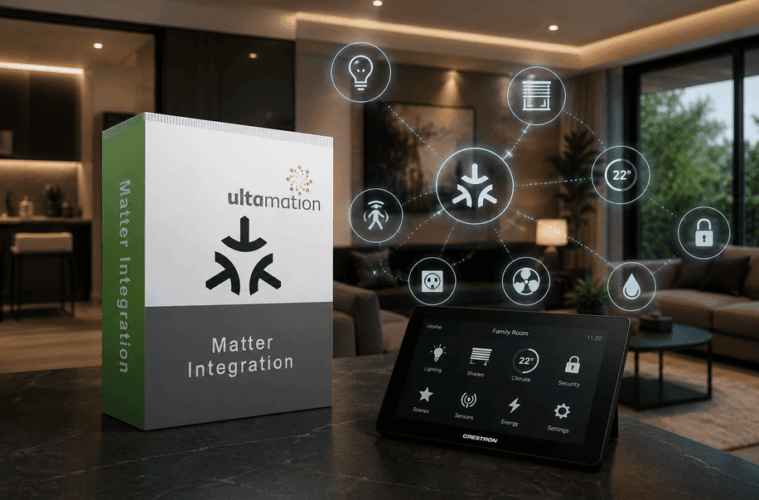
Ultamation has undertaken that implementation for Crestron, and the result is a production-ready Matter integration covering an extensive range of device types: lighting (dimmable, colour, colour temperature), plugs, switches, fans, thermostats, shading, smart locks, robot vacuum cleaners, contact sensors, occupancy sensors, light sensors, temperature sensors, humidity sensors, leak detection and more, with additional device types being added continuously to cover the extensive Matter ecosystem.
Ultamation’s approach prioritises both ease of deployment and flexibility. Its dedicated commissioning tool handles device setup and removes the friction of manual fabric configuration. For common device types, ready-made SIMPL module wrappers provide a clean, consistent programming interface. Where integrators want to go further, exploiting device capabilities or supporting hardware not yet covered by an official wrapper, ‘cluster’-level access is available to build upon.
For Crestron 4-Series custom processor deployments, the integration is available today. For Crestron Home integrators, whilst Crestron Home currently awaits native IPv6 support (a prerequisite for Matter), the solution is accessible now via a custom processor running alongside the Crestron Home deployment using Ultamation’s SIMPL Home and some straightforward plumbing programming to bridge the two environments. Exploiting the combination of SIMPL Home and Matter presents a practical path to capabilities that your competitors are unlikely to be offering.
The Ultamation Matter integration is available now from the Ultamation shop.