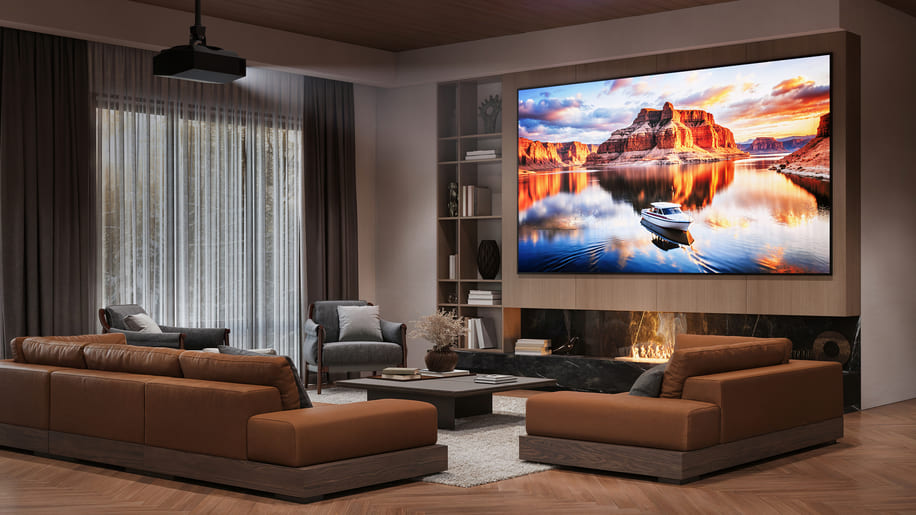

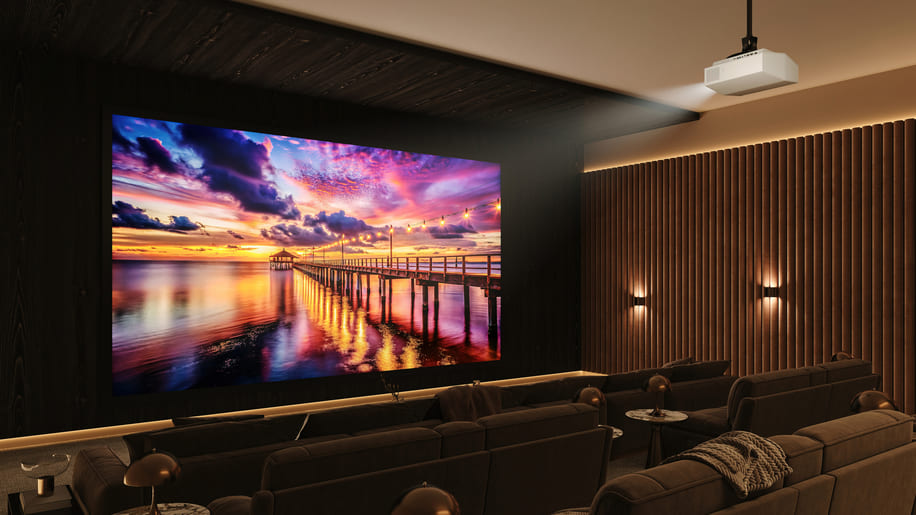
Sony’s new entry-level Bravia 7 projector (VPL-XW5100ES) brings the brand’s XR processing and a laser engine delivering 2,200 lumens to a rather accessible price point. Our trade focused reviewer Richard Stevenson takes a look.
I went all wobbly bottom-lipped when the Sony Bravia 9 comprehensively outgunned my own VPL-XW7000ES, thanks mainly to the shift from X1 to XR processing. Could the new Bravia 7 with XR processing do the same to the well-regarded VPL-XW5000ES? Well, yes, it does, creating a stunning dark-room cinema image at less than half the retail ticket price of its step-up brother.
At the heart of the XW5100ES lies the same trio of 0.61-in SXRD panels that define Sony’s latest approach to true 4K cinema. Unlike single-chip designs that simulate 4K through pixel-shifting, Sony’s native-resolution SXRD architecture delivers a full 8.3-million-pixel image for each frame. The projector’s Z-Phosphor laser light engine, with its rated life of 20,000 hours, should ensure performance for the long haul without the diminishing brightness of bulb-based designs. Probably more practical for end users is that lasers get up to full brightness a lot quicker than bulbs and, if this super-quiet projector’s fan is anything to go by, run a lot cooler.
I would say the incredibly low noise is a key feature of the Bravia 7, as even at full laser brightness the fan noise is as quiet as, or maybe quieter than, the 7000ES at 80%. Sony lists the BRAVIA Projector 7 with a claimed acoustic noise of just 24 dB, which puts it among the quietest native-4K laser projectors in its class.
Of course, 80% of 3,200 lumens is still a few hundred lumens higher than the Bravia’s 2,200 and, side by side, that is clearly noticeable. Sony suggests the brightness is good for screens in the 100 to 130-in range in ‘light-controlled rooms’, and I would say the latter is a practical maximum. For mixed media rooms with living room décor and some light bleed from outside, you would want to be at 100 in or less or deploy a screen with some gain.
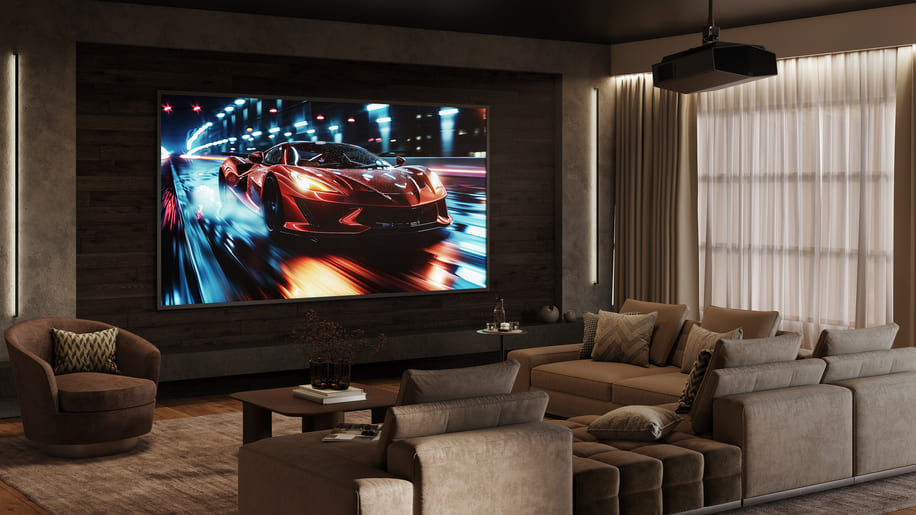
Dynamic contrast is claimed to be effectively limitless thanks to laser dimming, while native contrast around 16,000:1 gives the image trademark Sony depth and black-level stability. The XR Processor brings with it a set of image-processing technologies more familiar from Sony’s television division: XR Dynamic Tone Mapping, XR Deep Black, XR Triluminous Pro and XR Clear Image. It’s been a while since I have seen an older 5000ES, but knowing how much all this tech improved the step up from the 7000ES to the Bravia 9, this is a big uptick, particularly with HDR content.
The other major upgrade is the inclusion of HDMI 2.1 connectivity with support for 4K 120 Hz input and a measured latency as low as 12 milliseconds in Game Mode. That makes the XW5100ES one of the first genuinely dual-purpose Sony projectors that could be used as both a serious home cinema machine and satisfy the PlayStation 5 or Xbox gamer. Having never really got past Donkey Kong and Rick Dangerous, I may not be best suited to comment here, but for integrators building hybrid cinema-gaming rooms, it adds a whole new sales angle.
Physically, the projector remains Sony’s signature angular form, which I have always thought gives a nod to a Star Wars Empire-class destroyer. I might just be a geek. The surface texture of the case has got a little more ‘rough’ than previous generations, which isn’t an issue in use but does show finger marks and dust when installing.
At just over 13 kg, it’s easy to partner with a ceiling mount, and its 1.38–2.21:1 throw ratio and fairly generous lens shift (±71 per cent vertical, ±25 per cent horizontal) are good. That lens shift offers around 10% less adjustment scope than the step-up models, but I can’t foresee too many installation situations where that might be an issue.
What is a little disappointing is the engineering behind the manual lens shift adjustment itself. I get the cost saving of not having motors, but the manual lens position adjustment has the clunkiest pair of wheels I have ever used on a premium projector. There is a massive amount of slack when you reverse direction and harsh ‘sticky’ jumps that make accurate image positioning a bit of a PITA. OK, you may only ever have to use this adjustment once during set-up and never again, but it could feel a whole lot better.
That said, the lens and its control electronics are not short of features. Aspect Ratio Scaling affords switching between 16:9 and 2.35:1 content without mechanical lens shifts. For clients with a CinemaScope screen, this is a handy step-up feature not seen in the older 5000ES, albeit likely at the expense of some resolution compared to a true anamorphic lens. Support for such remains present in the installation menu, with scaling options for 1.24× or 1.32× lenses, meaning integrators can add a dedicated anamorphic piggy-back lens if required. Lens focus and zoom are also manually controlled, so installations demanding full lens memories for multiple aspect ratios will still need one of the step-up Bravia models.
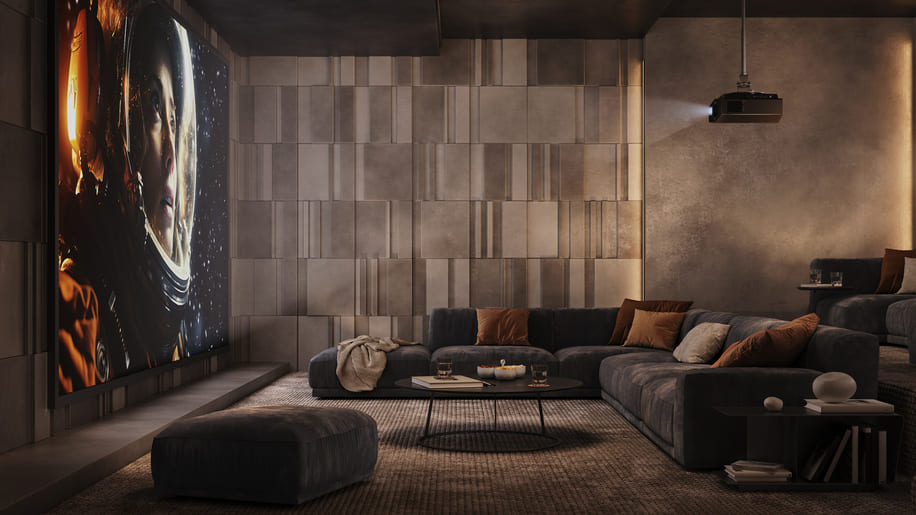
CONNECTIVITY AND CONTROL
Control options here include LAN, RS-232C and IR, with Crestron, Control4, Savant and AMX all supported via existing or forthcoming drivers. Network control allows remote monitoring and diagnostics, useful for service contracts or proactive maintenance within larger CI projects. The 12-volt trigger socket remains output only. This is a personal ‘irk’, as it doesn’t allow the AVR to simply power on the projector without some sort of control system integration. The feature is designed to trigger screen drop or raise, or limited masking and its 12-volt 100 mA output will be fine for just that, but why no trigger input exists on Sony’s projectors remains a frustration for me at least.
You can forgive its foibles as soon as it’s powered up, however, as Sony continues to shine in its colour science and motion-handling tech. The XR Processor’s dynamic tone mapping gives HDR material a convincing balance between shadow detail and highlight control, and colour saturation benefits from Sony’s Triluminous Pro engine, giving skin tones a superbly realistic vibe. It’s close to set-and-forget even without calibration and the picture balance in almost all standard picture modes is perfect for day-to-day content viewing. I settled on Cinema 2 with the brightness and laser power nudged up, but with precious few other tweaks. Colour rendering, motion and contrast are all very good and, save for the significant drop in brightness, the overall image quality is not far shy of the Bravia 9.
It may not match some rivals for sheer lumen output, but the Bravia 7 delivers an image that feels composed and cinematic rather than aggressively bright, which plays directly to the expectations of the mid-tier home cinema market. That makes it arguably the smart-money choice in the line-up. It delivers all the benefits of Bravia-series native- 4K three-chip architecture, XR processing and integration support, while saving money by chopping off the nice-to-haves like a motorised lens and an ultra-high-output laser.
For larger screens or rooms with some ambient light, such as partially shaded windows or rooms with light-coloured walls that re-reflect some of the screen lux, you will need to step up to the Bravia 9, as the 2,200 lumens here really isn’t that bright. Yet for the bulk of real-world cinema installs, with screens up to 130-in diagonal and a Henry Ford-approved décor palette, the Bravia 7 is an outstanding performer.