

 Daniel J Sait
Ligna Energy announces it is attending Embedded World 2026 in Nuremberg, where the company is showcasing ultra-thin energy storage technologies designed to support smaller, longer-lasting and more sustainable connected devices.
Taking place in Germany, the event sees the Swedish energy storage specialist demonstrating solutions aimed at helping engineers design sensors and wireless electronics that can operate without traditional batteries. The focus is on enabling discreet industrial design and reducing maintenance requirements in smart building deployments.
Visitors to the show can meet Ligna Energy in Hall 2, Booth 2-230, where the company is appearing alongside ecosystem partners to discuss complete IoT system building blocks, including sensing, wireless connectivity, power management and energy harvesting.
Key themes being explored at the event include the journey from smart cards to smart buildings, design-for-scale thinking, discreet sensor design and the growing potential for battery-free indoor sensing.
The company says its work with ultra-thin energy storage has led to an interesting design question: why can’t building sensors adopt the same design discipline as smart cards? Electronics continue to become thinner, more efficient and more cost-optimised, yet many building sensors still rely on bulky housings and replaceable batteries.
For the smart home and smart building sector, this shift toward battery-free technology is particularly significant. As connected devices become more widely deployed throughout homes and commercial spaces, the ability to power sensors without traditional batteries removes a major maintenance burden and supports more sustainable system design.
“Battery replacement is one of the ‘taxes’ – it adds service visits, waste and cost,” says John Söderström, Marketing Director at Ligna Energy. “At Embedded World, we’re showing practical building blocks that help teams move from promising prototypes to deployments that scale.”
At the show, the company is presenting Gwen, a battery-free indoor climate sensor reference design created to explore how smart card-style design principles can be applied to IoT sensors used inside buildings.
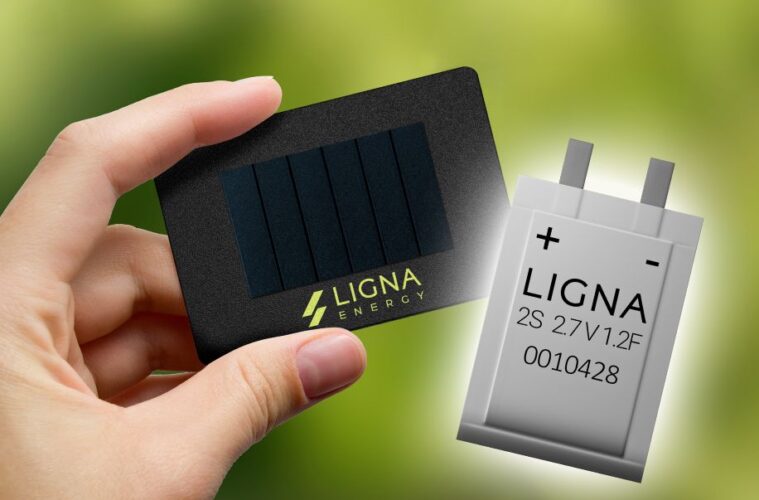
The design prioritises thinness, power efficiency, material reduction and scalability. Gwen harvests energy from its surrounding environment, storing it in Ligna Energy’s S-Power 2S supercapacitor while measuring temperature and humidity. Data is transmitted using Bluetooth Low Energy (BLE), removing the need for traditional batteries and enabling maintenance-free operation.
According to the company, this approach opens up new possibilities for sensor placement, allowing devices to be installed in locations where bulky enclosures would previously have made deployment impractical.
During the event, Ligna Energy is also sharing insights from its demonstrator projects, examining how ultra-thin energy storage and minimal material usage can support new form factors for indoor sensing and asset tracking applications. Rather than presenting a one-size-fits-all device, the company says the aim is to provide a flexible foundation that original equipment manufacturers and solution providers can adapt to their own designs.
Söderström adds, “Battery-free can be a better product experience. When routine battery swaps are removed, operations become simpler and new possibilities emerge for where sensors can be placed, including thin or discreet installations where bulky housings are not viable. This also simplifies end-of-life handling by reducing the need to remove and process batteries separately when devices are retired.”
The company also highlights its work on sustainability and product transparency. Ligna Energy has published Environmental Product Declaration (EPD) and Life Cycle Assessment (LCA) data for its S-Power supercapacitors, reporting a cradle-to-gate carbon footprint of 12g CO₂e per unit.
For installers, integrators and manufacturers working in the smart home and smart building space, developments like this are increasingly important. As connected devices multiply across modern homes, reducing reliance on batteries could play a key role in creating systems that are both easier to maintain and more environmentally responsible.