


 Daniel J Sait
Informed personal preference should be a big part of system building. Listen and learn to build better systems. Stereo v surround sound is a key one.

Every now and then I find myself writing a headline designed to raise a few eyebrows, and this one certainly will. ‘Is Stereo is better than surround sound?’ is not a question in this instance rooted in technical facts, or a dismissal of the extraordinary work installers do with immersive audio. But for me the answer is yes. This is a personal view born from experience, preference and budget, and one that I think applies to more homeowners than we often admit. It comes down to a simple idea: the system that best suits the customer, their space and their lifestyle is the system they should have, not the system the industry thinks they ought to want.
I love watching films, music documentaries and live concert recordings. I also love listening to music in a way that feels natural, engaging and emotionally familiar. For me, the answer to this collection of priorities has always been stereo. More specifically, 2.1. That choice is not driven by technical limitations or a lack of enthusiasm for multichannel sound. Far from it. A well-executed surround sound system can be breathtaking. It remains the backbone of home cinema design for very good reasons. But my own space, my own habits and my own listening preferences all point firmly towards stereo as the better all-round solution.
Part of this comes from how I grew up consuming media. Stereo was the language of sound in the home. It shaped my expectations and taught my ears how a mix should feel. Even now, when switching between platforms, content types and formats, stereo feels consistent, balanced and grounded. It delivers an experience that works just as well for a late-night film as it does for a Sunday afternoon playlist. I find that the stereo image anchors me in a way that surround sometimes does not, particularly when I am hopping between broadcasters, streaming services and apps, all with their own loudness quirks and format variations.
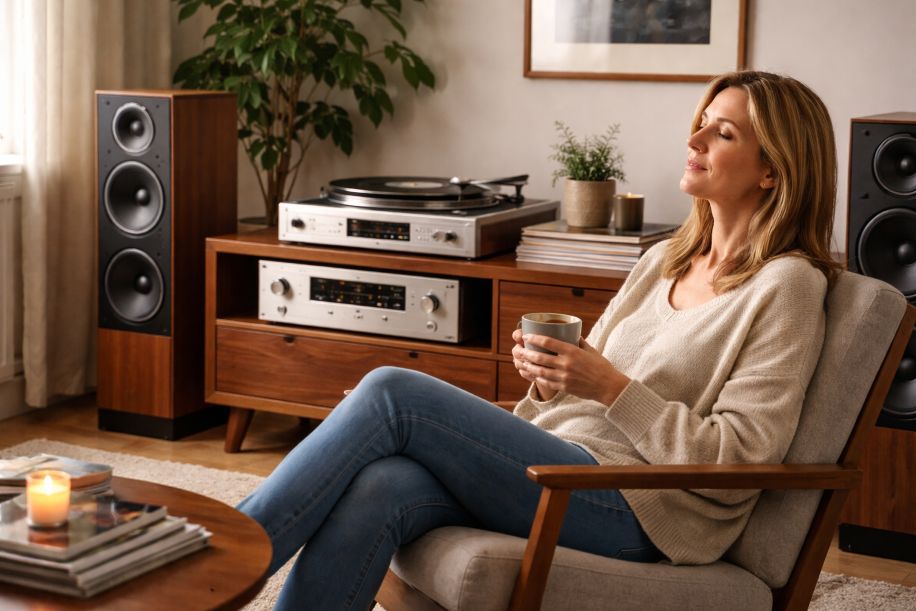
Then there is the practical side. Our room could support a surround system. A good installer could design a superb 5.1 or larger layout without breaking a sweat. But with the budget we had set for this space, the choice became clear. We could stretch the funds across more speakers or invest more heavily in fewer but better loudspeakers. We chose the latter and I am convinced it was the right decision. I suspect many installers have seen households facing the same question. We also recently invested in a new amp, the excellent TDAI-2210 from Lyngdorf Audio. Part of a new breed of compact, powerful amps and receivers that are perfect for systems like these. Whilst many of these amps are capable of doing far more than I will ask it to channel-wise, however the investment is definitely audible and also noticeable in upgraded control and calibration. So more modest stereo or 2.1 systems like mine are available for upgrade, not just the larger multiple channel products.
The heart of the matter
This is the heart of the point I want to make. As an industry, we are sometimes guilty of assuming that bigger, broader and, more immersive, automatically translates to better. Most of the time, surround sound is indeed the correct recommendation. But not always. There are rooms, budgets and lifestyles where stereo is still king, delivering a cohesive and enjoyable experience across a wider mix of content. Customers should not feel that they are stepping down by choosing fewer channels. They are simply choosing what makes the most sense for them.
Great installation work is not about selling the most complex specification. It is about understanding people. Their habits. Their daily patterns. Their preferences. Their spaces. It is about listening before designing. A stereo system built around high quality, well-positioned loudspeakers and a considered subwoofer integration can offer astonishing performance for films, music and general viewing. For many rooms and many homeowners, it might just be the optimum balance of cost, simplicity and joy.
So yes, the headline is deliberately bold. Surround sound remains essential in our sector, and rightly so. But stereo has never stopped being relevant. In some homes and for some audiences, it is still the best answer. The key is not whether it is two channels, or five, or more. The key is whether the system fits the person who will live with it every day.